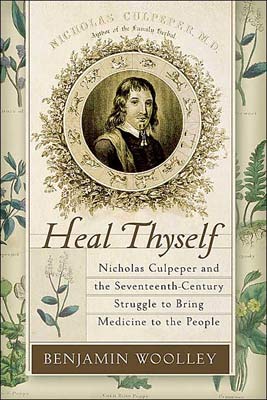
HEAL THYSELF: NICHOLAS CULPEPER AND
THE SEVENTEENT-CENTURY STRUGGLE TO BRING MEDICINE TO THE PEOPLE.
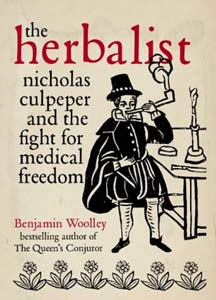
Heal Thyself: Nicholas Culpeper and the
Seventeenth-Century Struggle to Bring Medicine to the People
by Benjamin Woolley, published UK Feb 2004,
Harper Collins, in USA and Canada July 2004, pages i-x,
402 pp
 Although
this book does not mention homeopathy and the events it describes occurred
in the 1600s, a century before Hahnemann was born; nevertheless, it
reveals a real struggle, a familiar pattern whenever any vulnerable
medical minority finds itself pitted against a tyrannical medical
monopoly. It is the story of a person who made the College of Physicians
in London look very foolish, and his laughter somehow echoes enduringly
even down to our own times. There is a lesson to be learned from this
story by all devotees of homeopathy and natural medicine. It is also a
pleasure to recommend a book that is delightfully written, enriched by
deeper themes and which vividly brings to life a whole epoch of the past.
This review showcases comments from twelve prominent UK reviews of the
book.
This book contains “frequent quotations
from contemporary documents,” [2] written with “pace and
panache.” [1] It is “a gripping assemblage of facts, figures and
stories.” [3] Woolley produces “a lucid narrative,” [5] an
“immensely readable book,” [6] adorned with many “light,
humorous touches.” [6] Being more than a biography, it is also
“a profound examination of 17th-century trade practices and
monopolies.” [6] It is “a fascinating historical treatise,”
[7] “crammed with details of 17th-century life.” [8] Woolley
interweaves “the careers of Harvey and Culpeper to make comparisons
between them,” [8] detailing the “struggle between the two men
and the narrative is pacey and easy to absorb.” [5] Culpeper is
“brilliantly brought to life.” [12]
This “terrific story,” [10] makes “such
a compulsive read.” [12] It is “a wonderful book—a delight to
read, fast-moving, informed and passionate in its advocacy. It is a vivid
and compelling portrait of the world turned upside down.” [12] It is
“a remarkable and superbly enjoyable history of the period,” [2]
not so much “a biography as a very decent piece of 17th century
history, with the emphasis on medicine, religion and astrology, but with
lashings of politics thrown in.”
Culpeper’s life
Culpeper’s “extraordinary life,” [2] began
when he was born “in 1616, two weeks after the death of his
father,” [1] “the wayward child of a family of clergymen and
minor gentry.” [10] The “son and grandson of clergymen,”
[5] he “was reared by his maternal grandfather,” [8] an
“unpopular and unaccommodating rector.” [11] At the age of 16,
he “went up to Cambridge, where he learned some radical ideas,”
[8] “acquired a legendary addiction to smoking tobacco,” [3] and
became acquainted with a beauty he planned to marry. Tragically, “her
coach was struck by lightning,” [1] on the way to meet him. Outraged
by this intriguing incident, his family disowned him and he was forced to
“abandon his education at Cambridge,” [4] which he left
“disgraced, disinherited and in “deep melancholy,” [11] and
“his studies incomplete.” [1]
In 1634, aged 18, “Culpeper arrived in London with
£50 in his pocket and a tobacco habit, looking for an
apprenticeship.” [6] He soon began “an apprenticeship to an
apothecary, but abandoned that too in 1640, and set up instead as a
freelance astrologer and medical practitioner,” [1] “in St Mary
Spital.” [11] Though Culpeper “became apprenticed to an
apothecary,” [3; 6] he did not complete, and was therefore a
“rogue apothecary.” [10] Culpeper swiftly became “one of
London’s best-known medical figures, showing a practical expertise that
the expensive and autocratic physicians often lacked,” [9]
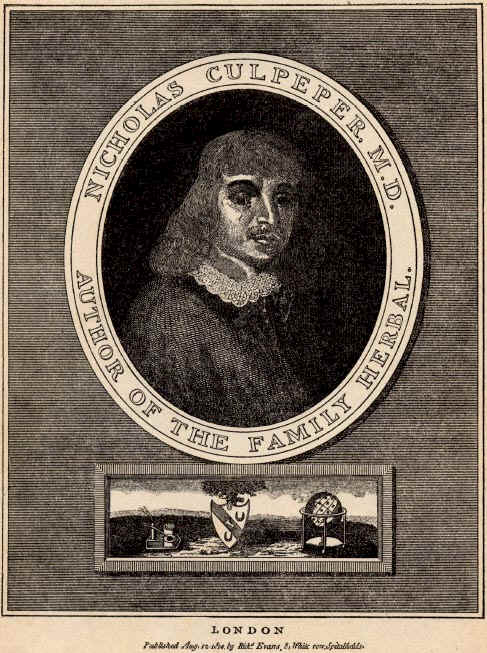
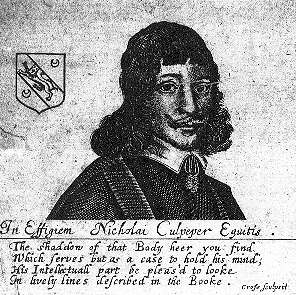
Culpeper was “a man with a long sad face,
shoulder-length hair with a fringe and an up-curling moustache.” [3]
A “natural rebel, he was opposed to the doctors monopolising medical
practice, to their great profit, through the College of Physicians.”
[2] He “was unusually disreputable, never qualifying properly and
always trying to evade the attempts of its legal practitioners to throw
him out of London,” [10] He did tend to “revel in notoriety,
indulging flamboyantly in booze and the new drug of tobacco, passing
through a succession of radical religious sects.” [10] He was
“imprisoned at least twice, for both medical and political
infringements.” [3] However, “his popularity,” [9] was
obvious for he “attracted up to 40 patients a day.” [9] He was a
“political radical, unqualified apothecary and self-taught populist
healer.” [1] He died “possibly of lingering complications from
his civil-war chest-wound, on January 10 1654, at the age of 37,” [1]
Poverty, exhaustion, and smoking had contributed to his demise.
College of Physicians
Founded by Henry VIII in 1518, the “pompous and
powerful College of Physicians, whose members practised medicine as
promulgated by Galen a millennium and a half earlier,” [3] regulated
the work of physicians and apothecaries in London. Their “only legal
book of recipes for medicines was the Pharmacopoeia Londoniensis.”
[3] Being “aloof and expensive,” [12] physicians “passed on
the largely unquestioned dicta of ancient authorities.” [11] The
“exclusive use of Latin by the college,” [2] helped it maintain
“its grip on healing mysteries,” [2] for “all medical
texts, were invariably published in Latin.” [5]
Hence, all “official medical knowledge,” [7]
was closed to the uneducated person; it was “printed and discussed
only in Latin;” [7] “all their procedures were in Latin,”
[3] By employing “the often illegible, obfuscating style of doctors’
prescriptions long remained the norm,” [3] so “doctors hung on
to the secrets of their profession.” [12] This story concerns
“the greed and paranoia of professionals who wanted to keep knowledge
to themselves,” [7] so protecting “medicaments for the sake of
profit”. [6] The obvious “power of England’s medical men is well
described. The bitter rivalry between the apothecaries, surgeons and
physicians is very well teased out.” [8]
William Harvey
 William
Harvey occupied a pivotal position in 17th century English
medicine, being the head of the College of Physicians and thus Culpeper’s
chief adversary. Woolley’s villain is “William Harvey,
university-trained, trusted personal physician to King Charles I.”
[1] His name is “permanently on the historical record, because he
discovered the circulation of the blood.” [1] Harvey was “cold,
austere, pompous, efficient, politically and religiously conservative,
successful and respectable.” [10] Culpeper, in contrast to Harvey,
“has been weeded out of the historical record,” [1] according to
Woolley.
Harvey was a “pioneer of the scientific method and
in every other way a deep-dyed conservative.” [5] His work was
“weighty with lasting influence;” [1] he had “charge of
Charles I’s children, Charles and James, at the battle of Edgehill; he had
a substantial apartment within the royal palace at Whitehall.” [1]
Harvey continued to “exercise considerable influence in medical
circles through his senior position in the College of Physicians.”
[1] He was clearly “an arch-establishment figure, the court
physician,” [11] who “wielded significant influence in medical
and royal circles.” [4] He certainly “had the ear of Charles
I.” [4] Harvey indulged a “commitment to the king and a divinely
sanctioned separation between aristocracy and commoners.” [1] He was
“a dyed-in-the-wool Royalist and a mainstay of England’s medical
establishment.” [8] As Woolley makes very clear, he represented
everything Culpeper detested.
Apothecaries
Apothecaries dispensed drugs and since medieval times
had occupied a position junior in prestige to physicians. Their job
“was to make up the prescriptions,” [3] and most of them
“had some idea of what their medicines did.” [6] However, they
“also knew that the College of Physicians had it in for them.”
[6] In essence, they treated the poor, and “with their use of herbs
and simples, they were medicine for everyman.” [12] Because of
long-standing professional frictions between physicians and apothecaries,
“trade and turf wars seem to have defined the medical system of the
next 100 years.” [6] During epidemics, many doctors escaped London to
reside in the country. For example, “the plague of 1625 left London
almost empty of doctors, with only apothecaries still providing medical
care.” [6]
The Times
Woolley depicts the 1600s as an “era of
revolutionary pamphlets,” [11] with a vibrant “intellectual
underground,” [10] and his sketches of London reveal “a great
city dissolving into chaos.” [12] The country “was gripped with
terror. There was plague, famine, civil war.” [4] Such were times of
“enormous turbulence, which were capped by the execution of Charles
I.” [2] Culpeper “eagerly supported the revolution that toppled
Charles I and destroyed the English monarchy in 1649,” [10] the same
year he published his Herbal. Woolley depicts the “acrimonious,
half-crazed, thrilling, terror-ridden sub-culture of the city, when
apprentices seethed against their masters,” [11] with widespread
“fragmentation of public opinion.” [3] Democracy was,
“creakingly, on the move, amid an incoherence of cults, sects and
superstitions.” [5] Culpeper’s medical struggles “paralleled
wider political divisions: King and Parliament, authority and conscience,
licensed doctor and unofficial healer.” [5]
Culpeper “worked underground, in a world of
religious sects, producing pamphlets printed on clandestine printing
presses and used his self-taught medical knowledge in unlicensed
apothecary shops,” [4] shops that were “anathema to the College
of Physicians.” [4] He “espoused the radical politics which were
the norm in London.” [8] Under “the eye of his widow, Culpeper’s
books became the height of medical fashion. Pirated editions of his work
flowed off printing presses across England.” [8] Thus “two
connected revolutions are explored in this book: one in the body politic,
and one in the way our individual bodies are treated.” [3] England in
general, and London especially, seethed with political radicalism and
religious dissent.

His Mission and legacy
As a committed republican, Culpeper despised
“hierarchical, élite medical practice for initiates only.” [1]
He thus decided to publish “a translation into English of the
college’s Pharmacopoeia. The physicians were outraged, especially as
Culpeper also included instructions on how to use the cures and sold the
book at an affordable price. His later publication, The English Physician
Enlarged, or the Herbal became another bestseller.” [2] The book soon
became “one of the most enduring bestsellers of all time.” [3]
Politically and professionally, it was “an act of defiance,” [3]
and his own “great contribution to people-power.” [3] For
example, “his preface, with its reference to ‘The Liberty of the
Subject’, shows that he understood the political resonance of what he had
done.” [3] It clearly reveals Culpeper as a radical Puritan,
“committed to demystifying medicine for the ordinary man and
woman.” [4]
In essence, Culpeper was “a Latinist who rejected
the elitism of that tag.” [5] Just “as Levellers called for all
legal matters to be conducted in English, so Culpeper’s thoughts turned to
a similar democratisation of medical texts.” [6] He therefore
translated “the semi-secret reference book Pharmacopeia Londiniensis
into English,” [5] releasing it as “a cheap edition.” [5]
He “did in medicine what the vernacular Bible had done in
religion.” [5]
Culpeper’s practice and his published works were part
of his “conscious political struggle to bring medicine to the people,
rescuing it from the reactionary institutions which had hitherto
controlled its use.” [1] His “well-intentioned popularising of
naturally occurring,” [1] remedies was “one of many ad hoc
attempts at self-help,” [1] His “egalitarian attitude towards
medicine and his commitment to making simple herbal remedies available to
the public at large were part and parcel of his political commitment to
the Commonwealth and its revolutionary principles,” [1]
Culpeper ‘s “Compleat Herbal,” [12] was
“a groundbreaking publication,” [12] and became “one of the
most popular and enduring books in British history.” [6] He regarded
“kings, priests, lawyers and licensed medics…all as the enemies of
human welfare,” [10] and he reserved “his most ferocious attacks
for doctors.” [10] Having “enraged the College of Physicians by
giving away many of their secrets,” [7] Culpeper “prided himself
on giving medical assistance to anyone who came to his door.” [12]
Such bold radicalism made him “feared by the physicians;” [4]
his enemies even “called him “Culpaper”, the
Arse-wipe.” [5]
Remedies
The book discusses some of the “remedies for all
the ills known to 17th-century society.” [7] For example, “some
thistles in wine which expel ‘superfluous Melancholy out of the Body, and
make a man as merry as a Cricket’…” [3] or “chamomile for a
good night’s sleep.” [6] There was “Pilewort…which readily
cures both the Piles or the Haemorrhoids, and the King’s Evil, if I may
lawfully call it the King’s Evil now that there is no King.” [6] In
official medicine there were “bizarre items like excrement of wolf,
human blood, crayfish eyes, sweat, ass milk and “intestines of the
earth” (earthworms),” [6] and “opium, which, at the time,
cost less than rhubarb.” [6] By contrast, Culpeper recommends
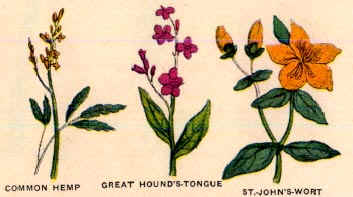
“familiar hedgerow plants,” [1] as gentle healers “if
picked under the right stars.” [11]
Culpeper was espousing a
“pick-your-own-and-dose-yourself guide to free medicine for the
masses,” [11] familiar herbs which could be picked “just a short
walk from the city walls.” [12] He was telling “housewives how
to treat ailments in the home,” [4] using herbs which were
“readily available in the hedgerows.” [4] Culpeper is full of
“no-nonsense advice that the good housewife could put to use in her
own family.” [12] By thumbing his nose at medical authority, he was
effectively “giving short shrift to the expensive doctors.” [4]
Alternative Medicine
There is little doubt that Culpeper is a hero-figure
for “advocates of alternative medicine today,” [1] who believe
that “Culpeper’s remedies retain their therapeutic usefulness.”
[1] He was also a pioneer of “today’s ever-simmering argument between
science-based medicine and alternative therapies.” [5] Certainly this
was “prefigured even when medicine itself was pre-scientific.”
[5] Culpeper professed “a complete system of “alternative”
healing,” [6] and promoted the “use of plants to heal yourself
or your own family.” [6] He is thus regarded “in some quarters
as one of the patron saints of New Age medicine.” [8] This book
augments that image, reminding us that he remains “as beloved in the
field of natural medicine as Shakespeare is in drama.” [10]
Culpeper’s “holistic view of medicine, upset the
establishment.” [6] For example, “one of his main criticisms of
physicians was that they concentrated on the disease rather than the
patient.” [7] Even though this was “medicine that belonged to
the pre-mechanistic, pre-Newtonian age,” [12] yet “Culpeper’s
approach now seems curiously modern.” [7] His radicalism “in
opposing chemistry and developing a theory of natural cure and
self-healing,” [5] also resonates with medicine today. The ancient
view that saw “the link between malady and the occult influences of
the stars,” [12] and “looked to the heavens to explain mortal
afflictions,” [12] may have been eclipsed, but many today are still
“starry-eyed about primitive medicine.” [11] Even his challenge
to commercialism has a distinctly modern ring: “imagine the anger of
the drug companies today if a rebel chemist published a list of herbal
extracts that could match their best-selling products for a tenth of the
cost.” [9]
Culpeper clearly “sparked off a debate about
patient power that is still unresolved today.” [7] By highlighting
that people are “denied control over their medical treatment,”
[6] this implied that “medicine is too important to be left to the
doctors.” [8] By challenging “the principle that medical
knowledge belonged solely to physicians—indeed that expert knowledge of
any sort belonged to the experts, he helped to reveal a division that has
yet to heal, between orthodox and alternative medicine, between
professional expertise and personal empowerment.” [8] Culpeper’s
chief legacy is “the idea that medicine is not something that should
be controlled and administered by the elite but something belonging to
everybody—is as important and, perhaps, as revolutionary, now as it was
in the 17th century.” [6] This makes this story still very relevant
today.
Sources
 [1]
[1]
Lisa Jardine, Royalist vs. Radical: William Harvey and Nicholas Culpeper
in Benjamin Woolley’s the Herbalist, The Guardian, February 28, 2004, p.14
[2] Roy Herbert, Natural Rebel, New Scientist, April 3,
2004, p.50
[3] Victoria Glendinning, Ahead of his Thyme, Daily
Mail, April 2, 2004, p.58
[4] Jayne Howarth, Medicine for the Man in the Street,
Birmingham Post, March 13, 2004, p.53
[5] Robin Blake, The Herbalist: Nicholas Culpeper and
the Fight for Medical Freedom, Financial Times, March 6, 2004, p.33
[6] Scarlett Thomas, The Boy Who Broke Every Rule in
the Book; The Herbalist By Benjamin Woolley, Independent on Sunday,
February 29, 2004, p.18
[7] Jenny Gilbert, Radio – Book of the Week: The
Herbalist’, Independent on Sunday, February 29, 2004, p.51
[8] George Rosie, The Medicine Man, The Sunday Herald,
Glasgow, February 29, 2004, p.11
[9] Miranda Seymour, He Spilled the Beans – The Honest
Apothecary Who Revealed the Medical Establishment’s Secrets, The Daily
Telegraph, February 21, 2004, p.6
[10] Ronald Hutton, The Alternative Medicine Man, The
Independent, February 20, 2004
[11] Caroline Moore, Medicine for the Masses – Nicholas
Culpeper’s ‘Herbal’ Meant that Treatment was no Longer Just for the Rich,
Sunday Telegraph, February 15, 2004, p.13
[12] Roy Strong, Curing Society’s Ills, Sunday Times,
February 8, 2004, p.41
Acknowledgement
I acknowledge my
grateful thanks to Gregory Vlamis of Chicago for supplying some
invaluable source material without which writing this essay would have
been rendered much more difficult.