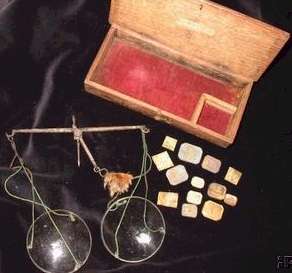
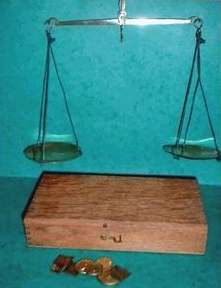
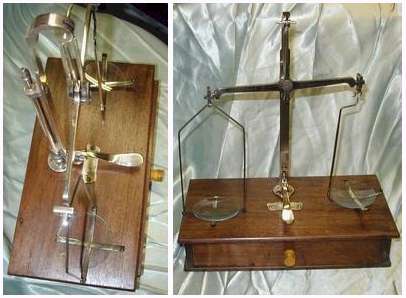
Tables of weights and measures. Apothecaries’
weight.
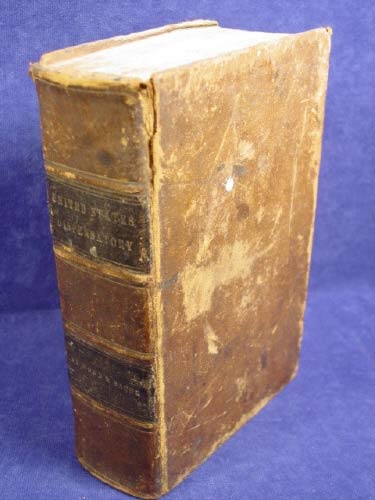
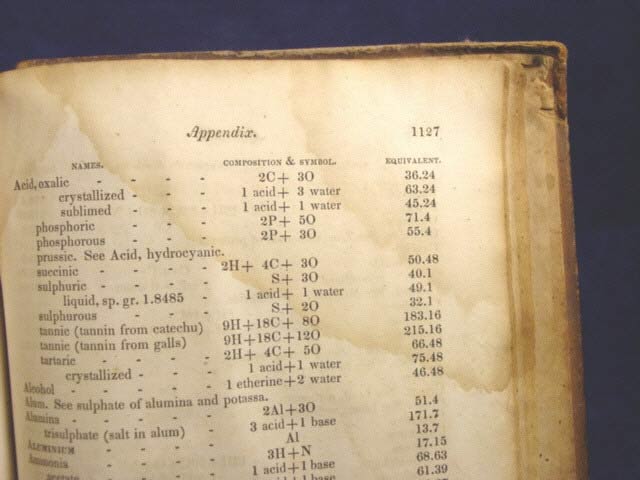
from The Dispensatory
of the United States of America, 13th ed.
By George B. Wood, M.D. and Franklin Bache, M.D.
Presented by
Sylvain Cazalet
 Pound.Troyounces.Drachms.Scruples.Troy Grains.
1
= 12= 96= 288= 57601
= 8= 24= 4801
= 3= 601
= gr.
20The Imperial Standard Troy weight, at present
recognised by the British laws, corresponds with the Apothecaries’
weight in pounds, ounces and grains, but differs from it in the division
of the ounce, which, according to the former scale, contains twenty
pennyweights, each weighting twenty-four grains.

Avoirdupois
weight. Br.Pound.Ounces.Drachms.Troy Grains.= 16= 256= 7000oz. 1= 16= 437.5dr. 1= gr.
27.34375Relative value of Troy
and Avoirdupois Weights.Pound.Pounds.Pound.Ounces.Grains.1 Troy=
0.822857Avoirdupois= 0= 13= 72.51
Avoirdupois=
1.215277Troy= 1= 2= 280
Apothecaries’ or Wine
Measure. U.S.Gallon.Pint.Fluidounces.Fluidrachms.Minims.Cubic Inches.Cong. 1= 8= 128= 1024= 61440= 231O 1= 16= 128= 7680=
28.875f= 8= 480=
1.8047f60
=
0.2256Imperial measure.
Adopted by the British
Pharmacopoeia.Gallon.Pints.Fluidounces.Fluidrachms.Minims.1= 8= 160= 1280= 768001= 20= 160= 96001= 8= 4801= 60Relative Value of
Apothecaries’ and Imperial Measure.Apothecaries’ MeasureImperialMeasure.Pints.Fluidounces.Fluidrachms.Minims.1
gallon=6132231 pint=165181
fluidounce=10201
fluidrachm=12.51 minim=1.04Imperial Measure.Apothecaries’Measure.Gallon.Pints.Fluidounces.Fluidrachms.Minims.1 gallon=119581 pint=131381 fluidounce=7411 fluidrachm=581 minim=0.96Relative Value of
Weights and Measures in Distilled Water at 60º Fahrenheit.
1. Value of
Apothecaries’ Weight in Apothecaries’ MeasurePints.Fluidoz.Fluidr.Minims.1 pound=0.7900031
pints=01257.22381 ounce=1.0533376
fluidounces=01025.60201
drachm=1.0533376
fluidrachms=0013.20021
scruple=00021.06671 grain=0001.0533
2. Value of
Apothecaries’ Measure in Apothecaries’ Weight.Gr.Grains.1
gallon=10.12654270
pounds=101408.88=
58328.8861 pint=1.26581783
pounds=131111.11=
7291.11071
fluidounce=0.94936332
ounces=007115.69=
455.6944*1
fluidrachm=0.94936332
drachms=000216.96=
56.96181 minim=0.94936332
grains=.9493
3. Value of
Avoirdupois Weight in Apothecaries’ Measure.Pints.Fluidoz.Fluidr.Minims.1 pound=0.9600732
pints=015253.36221 ounce=0.9600732
fluidounces=00740.8351
4. Value of
Apothecaries’ Measure in Avoirdupois Weight.1
gallon=8.33269800
pounds.1 pint=1.04158725
pounds.1
fluidounce=1.04158725
ounces.
5. Value of
Imperial Measure in Apothecaries’ and Avoirdupois Weights.Imperial MeasureApothecaries’ WeightAvoirdupois WeightGrains.Cubic Inches.1
gallon=
12=
10=
70,000=
277.273841 pint=
1…… 6 …. 1 … 2 …. 10= 1 ..
4= 8,750=
34.659231
fluidounce= ..
……………. 7… 0 …. 17.5= …..
1= 437.5=
1.732961
fluidrachm=
…………………….. 2 …. 14.69== 54.69=
0.216621 minim== .91=
0.00361
Oj. = 1 pint
gtts. ij. = 2 drops
grs. x. = 10 grainsWeightTroypoundouncedrachmscruplegraingram112962885760373,24170182448031,1034813603,887931201,2959810,06480Avoirdupoispoundouncedrachmtroy graingram1162567000453,59234116437,528,34952127,343751,7718510,06480Imperial Troypoundouncepennyweightgraingram1122405760373,2417012048031,103481241,5551710,06480VolumeTroygallonpintfluidouncefluidrachmminimmilliliter181281024614403785,411791161287680473,176471848029,573531603,6966910,06161Imperialgallonpintfluidouncefluidrachmminimmilliliter181601280768004546,091201201609600568,261401848028,413071603,5516310,05919
Biography of Dr
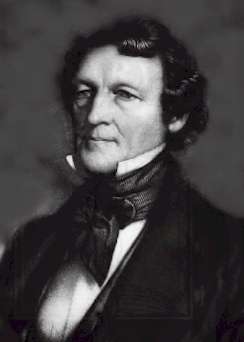
George Bacon WOOD
Presented by Sylvain
CazaletWOOD, GEORGE BACON (1797-1879) Poetry,
1820-1849
George Bacon
Wood M.D. (1797-1879)George Bacon
Wood was born in Greenwich, New Jersey, on 12 March 1797; he was the son
of Richard and Elizabeth Bacon Wood. George B. Wood married Caroline
Hahn (d. 1867) on 2 April 1823. Wood died in Philadelphia on 30 March
1879.In 1815,
George B. Wood received his A.B. from the University of Pennsylvania. He
then studied medicine under Joseph Parrish and attended courses at the
University of Pennsylvania. He received his A.M. and M.D. from the
University in 1818. Wood’s thesis was on dyspepsia. After his
graduation, Wood lectured on materia medica at Joseph Parrish’s
Association for Medical Instruction.George B.
Wood was one of the founders of the Philadelphia College of Pharmacy in
1821. He was Professor of Chemistry at the College (1822-1831), then
Professor of Materia Medica and Pharmacy (1831-1835). Wood resigned from
the College in 1835, to become Professor of Materia Medica and Pharmacy
at the University of Pennsylvania. In 1850, he became Professor of the
Theory and Practice of Medicine at the University and held that position
until his retirement in 1860. Wood was Attending Physician at
Pennsylvania Hospital (1835-1859) and President of the Board of Managers
(1874-1879). From 1850 to 1860, Wood was also chairman of the Committee
on the Revision of the United States Pharmacopoeia. In 1865, he helped
to organize the Auxiliary Faculty of Medicine at the University of
Pennsylvania.George B.
Wood became a Fellow of the College of Physicians of Philadelphia in
1827 and was President from 1848 to 1879. Wood was also a President of
the American Philosophical Society (1859-1879) and the American Medical
Association (1855-1856).Books:
– The dispensatory of the United
States (1833),
– History of the
University of Pennsylvania From its Origins to the Year 1827. (Philadelphia: University of Pennsylvania.
Historical Society of Pennsylvania by George B. Wood, M.D., 1834).
– A Treatise on the practice of medicine (1847),
– A Treatise on therapeutics and pharmacology, or
materia medica (1856).

The Dispensatory of the United States of America
Thirteenth Edition,
Carefully revised. Philadelphia: J. B. Lippincott and Co. 1876
By George B.
Wood, M.D. and Franklin
Bache, M.D.By George B.
Wood, M.D.,President of the
American Philosophical Society;
President of the College of Physicians of Philadelphia;
Emeritus professor of the Theory and Practice of Medicine in the
University of Pennsylvania, etc.,And
Franklin Bache, M.D.,Late Professor
of Chemistry in Jefferson Medical School of Philadelphia;
Late Vice-President of the College of Physicians of Philadelphia;
Late President of the American Philosophical Society, etc. etc.
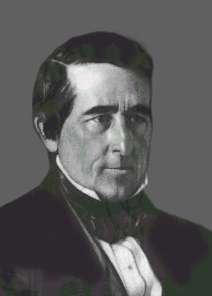
Franklin Bache M.D.
(1792-1864)This
book provides authoritative information about hundreds of common and
exotic medicinal agents known to mid-nineteenth century pharmacists. It
identifies the properties of plants and minerals, details their known
medical effects, and gives medicinal formulas. Conceived as a textbook
as well as a reference, it was accompanied by a volume of Dr. Wood’s
lectures.The
first pharmacopoeia published in England appeared in the early
seventeenth century. American druggists relied upon English texts until
1820, when the first Pharmacopoeia of the United States was
published. Stating the need for a more practical and accessible
reference guide than the Pharmacopoeia, the authors of the Dispensatory
described their publication as sensitive to “the history of our
commerce in drugs, and of the nature, growth, and collection of our
indigenous medicinal plants, and in the modes of preparing, dispensing
and applying medicines” peculiar to the United States.Extract:
CANNABIS
SATIVA. Hemp.from The
Dispensatory of the United States of America, 5th ed. (Philadelphia:
Grigg and Elliot, 1843)
An annual
plant, originally from Asia, but now cultivated in various parts of
Europe and North America. The leaves are possessed of narcotic
properties, and are employed in Persia and the East Indies, in the form
of infusion, as an intoxicating drink.; They are also smoked, in these
and other countries of the East, in the same manner as tobacco, with
which they are frequently mixed. A resinous exudation from the plant is
much employed for the same purpose. Even the odour of the fresh plant is
stated to be capable of producing vertigo, headache, and a species of
intoxication. According to Dr. O’Shaughnessy, of Calcutta, who has
experimented with this narcotic, it alleviates pain, exhilarates the
spirits, increases the appetite, acts decidedly as an aphrodisiac,
produces sleep, and in large doses, occasions intoxication, a peculiar
kind of delirium, and catalepsy. Its operation, in the hands of Dr.
Pereira, appeared to resemble very much that of opium. (Pereira’s
Mat. Med.) Dr. O’Shaughnessy employed an alcoholic extract of the
dried tops with great advantage in tetanus, and with alleviating effects
in a fatal case of hydrophobia. He gave the remedy usually in doses of
two or three grains, at intervals of two, three, or four hours; though,
in these violent affections, the quantity may be much increased; and in
hydrophobia from ten to twenty grains may be given at once. He employed
the remedy also in rheumatism and cholera, giving, in the latter
affection, ten drops every half hour, of a solution made with three
grains of the extract and a drachm of proof spirit. (Medical
Examiner, iii. 530)
The seeds
of hemp have also been used in medicine. They are about the eighth of an
inch long, roundish-ovate, somewhat compressed, of a shining gray
colour, inodorous, and of a disagreeable, oily, sweetish taste. They
contain a considerable quantity of fixed oil, which is separated by
expression, and used to some extend in the arts. They contain also
uncrystallizable sugar and albumen, and when rubbed with water afford an
emulsion, which may be used advantageously in inflammatory affections of
the mucous membranes, though it is not superior to a similar preparation
from other emulsive seeds. They are much used as food for birds, which
are fond of them. It is, however, for the fibrous bark of hemp, and the
various products manufactured from it, that the plant is chiefly
cultivated. Some consider the hemp cultivated in the East as
specifically different from the common hemp; and name it Cannabis
Indica, but most botanists think the two plants identical.Source: George B. Wood and Franklin Bache, eds., The
Dispensatory of the United States of America, 9th ed. (Philadelphia:
Lippincott, Grambo, 1851), pp. 310-311.
1836 RARE
Early Pharmacology Dispensatory of the U.S.
The Dispensatory of the
United States of America.
by George B. Wood and Franklin Bache. Philadelphia: Grigg & Elliot,
1836.
Third Edition. 1166 pages. Fully indexed. No illustrations.
Copyright © Sylvain
Cazalet 2001