Cholera infantum.
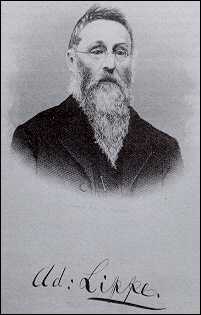
By Adolph Lippe, M.D.
Presented by Sylvain Cazalet
Comte Adolph
von LIPPE
(1812-1888)Cholera infantum, or,
as this form of disease is generally termed, “summer
complaint,” comprises all the various diseases of the digestive
organs and brain with which children are attacked during the summer, and
most frequently during dentition, during their second summer. The
various forms of diseases of the digestive organs are those attacking
the stomach as its principal seat, as catarrh, aridity, inflammation,
ulceration, or softening of it, or the intestines alone are the seat of
the disease, as an erythematous inflammation, catarrh, excoriations and
ulceration.The disease often
appears in different forms, at different seasons and in different
localities.The brain is very
frequently the seat of the disease from the very inception of it, and
the erroneous idea that a later stage of the disease itself develops the
various cerebral symptoms is only a proof that the first observations of
the state of the patient’s disturbed health were made inaccurately, and
that the cerebral symptoms had been entirely overlooked. The most
frequent brain disturbance from the very beginning of the disease, is
hydrocephaloid.If the observing healer
has found the cerebral symptoms (dilated pupils, hot head, cold
extremities, drowsiness) present in a child during hot weather and the
prevalence of cholera infantum, he may avert all further anxieties
(especially if the child also vomits) by administering a single dose of
Belladonna.The knowledge of the
seat of the disease, its name, or a knowledge of the stage in which we
find the disease, does not indicate a particular treatment, or indicate
the truly curative remedy ; but this knowledge is nevertheless
necessary, for it facilitates the examination of the sick, and it
enables the physician to classify the symptoms obtained, and to consider
as most important in each individual case, the symptoms indicating the
progress of disease in this or the other locality, and the changes or
suppression of one or the other function of organs. As an illustration
of these proposition, let us turn to a child supposed to suffer from
epidemic cholera infantum. We are informed that the child has diarrhœa
since midnight, but does not give signs of pain ; it lies quiet,
its eyes are only half closed, the anterior fontanel is elevated, the
face is pale, the wrists and feet are cold, and upon further enquiry
learn that the child has not passed any urine since the previous
evening ; the abdomen is flabby, not hot. It would be useless, in
such a case to select the remedy guided by the nature of the
evacuations. Here we are presented with a decided case of
hydrocephaloid, a case of great gravity, possibly to end fatally within
one, or at least a few a days ; and we further know that should the
patient pass urine within a few hours after the administration of the
truly homœopathic remedy (Sulphur in this case), the recovery becomes a
certainty, and probably without any further medication. Another child
has cholera infantum, and cries most persistently, has done so all
night, is cutting teeth, and the distressed mother says this screaming
has lasted all night ; “we have to carry the child all the
time to pacify it ;” it has frequent green discharges from the
bowels, preceded by an increase of pain, causing it to draw up its knees
to the abdomen ; the abdomen is hot, the thirst incessant ; we
are sure there is nothing the matter with the child’s brain but the seat
of tho inflammatory disease is in the small intestines. A dose of Chamomilla
will soon quiet the child.In the first case the
brain symptoms, with the concomitant suppression of the urinary
discharge, stand foremost ; in the second case the intestinal
symptoms, with the concomitant restlessness and the desire to be
carried, stand most prominent.Knowing that the
gravest cases of cholera infantum appear without any previous
indisposition, without any precursory diarrhœa, probably with no other
warning than a little more sleepiness of the otherwise, to all
appearances, well child, and that in just such cases all depends on the
proper choice of the first remedy, we be prepared before hand to choose
right, and administer the remedy according to the homœopathic law of
cure.It has been proposed to
begin the treatment of these grave cases of cholera infantum, having
their origin in a disturbed condition of the brain, by administering
Aconite and Bryonia in alternation. As this proposition is a violation
of all and every fundamental principle of our school, the result will be
a failure to cure. First and foremost, the character of the disease, its
locality, or its kind, can never serve as a guide to our therapeutic
action. Much less can the administration of two entirely differently
acting drugs, as are Aconite and Bryonia, be followed by salutary
results ; either one or the other case stand in the proper relation
as a therapeutic agent under the law of the similars, never both, and
why, then, not adhere to the law, and administer the simillimum ?The therapeutics
include also the dietetics, and in cholera infantum it becomes very
important to see to it that the proper nourishment is given to the
children. The better the dietetics of a child have been understood, and
the more proper the nourishment has been from its birth, the less liable
will it be to be attacked violently by the ordinary diseases of children
during the hot weather. There are general dietetic rules for the
children laid down in the books, and its all well to know them, but they
lend to generalizations ; each individual child wants its
individual diet, adapted to its individual constitutional condition. The
administration of crude substances supposed to be wanting in the
organism is based on “materialism”, the substances so wanting,
or supposed to be wanting, can at best only be supplied by food
containing them only in a greater proportion than its ordinary
nourishment did. The instinct of children will very frequently indicate
the requisite nourishment which then should never be withheld, even if
it is contrary to speculative science. In properly nourished children we
will rarely ever find a bad case of cholera infantum, and the more we
have studied carefully the proper diet of each individual child under
our care, the less will they be liable to diseases of the digestive
organs. Many cases of children come under the treatment of the physician
which he has never seen before, and the more general experience he has
gained about the proper diet of the children, the easier will he be able
to detect what mistakes have been made in each individual case, and he
will at once endeavor to correct the erroneous diet.The erroneous, but
generally accepted notion, that children should be nursed during the
second summer on account of the prevalence of cholera infantum during
that season, causes more cases and is the frequent cause of the great
mortality in that disease. There are nine months of the gestation, and
exactly nine-months of lactation (nursing and feeding by the mother’s
milk). The appearance of the teeth is the first indication that
farinaceous food is wanted and it must not be withheld, and as different
children cut their teeth earlier or later during the first nine months,
farinaceous food should be given as it is needed.All the dietetics being
properly attended to, the chief problem is to find in each individual
case the corresponding similar remedy. In grave cases, the choice of a
remedy must be made at once, as delay is attended by great danger. It is
the aim of these short pages to give characteristic symptoms, and a
concise description of frequently occurring combinations of symptoms in
this form of disease, with their correspondingly similar remedy.We shall first give the
most frequently indicated remedies, and then those less often called
for :
Apis :
the child is inclined to stupor, out of which it starts with a loud,
shrill scream. The eyes have a reddish tint. The head is hot. The tongue
is dry, and thirst is but seldom present. The skin is dry, the hands at
times cold and blue. Suppression of urine. The abdomen is tender to
pressure. The diarrhœa is worse in the morning, always mixed with
mucus, sometimes very offensive or involuntary, or containing flakes of
pus.
Belladonna :
The child lies in a stupor ; it frequently starts up suddenly in
its sleep ; when awake it is angry and violent, he head is hot, and
is often rolled from side to side. The face is Generally purple, red and
hot, or very pale and cold. The tongue is red on the edges, or coated
whitish yellow, or has two white strips of coating extending down on
both sides of the tongue. Thirst moderate, pulse very frequent, small
and hard ; occasionally full. Hands and feet cold ; the hotter
the head is, the colder are the feet. The abdomen is hot, the stools are
day color or green, or consist of white or granular yellow slimy mucus,
and very frequent.
Chamomilla :
The child is exceedingly peevish ; the guns are very hot, the
cheeks are red, at times only one cheek ; the child wants to be
carried all the time ; has attacks of colic, draws its knees up,
and seems to be relieved for a short time after a passage from the
bowels. Vomiting of food and sour mucus. The stools are green, or green
mucus at times mixed with white mucus, or chopped ; the discharges
are hot, excoriating the parts ; frequent sometimes smelling like
rotten eggs.
Croton Tiglium :
The child has a stool as often as it is fed or nursed. The discharge is
sudden, noisy, and violent, consisting generally of yellow water.
Ipecacuanha :
Diarrhœa
and vomiting. Vomiting of food and drink as often as one drinks, or
vomiting of green mucus. Much nausea, with pale face and oppressed
breathing. Stools are of green mucus, or are bloody or fermented.
Natrum Sulph :
Frequent attacks of violent colic, with rumbling in the abdomen,
relieved by the violent discharge of yellow water with large quantities
of flatus. The stools are more frequent during the morning hours, after
the child has been taken us and is moved about, like Bryonia.
Podophyllum :
Drowsiness or restless sleep, with grinding of the teeth or rolling of
the head. Vomiting of frothy mucus, green, or of food. The diarrhœa is
worse in the morning and the discharges are more frequent at night than
during the day. Stools green watery or mixed with mucus ; or like
chalk ; profuse and painless. During and after stool, prolapsus
ani. During dentition ; also catarrhal cough and catarrh of the
chest. Cramps of the feet calves and thighs.
Sulphur :
The disease generally begins after midnight ; diarrhœa and
vomiting, the discharges from the bowels are generally watery and green
and involuntary ; they sometimes smell sour, at other times they
are very offensive ; vomiting is frequent often smelling sour (like
Calcarea) ; with cold perspiration on the face (Veratrum, Cold
perspiration on the forehead). The face is pale the fontanels open,
hands and feet cold the very first morning ; the child lies in a
stupor with its eyes half open ; not much thirst and entire
suppression of urine. The child does not scream out violently as under
Apis, or roll his head as under Belladonna. In such a case as above
described one single dose of Sulphur will Suffice to re-establish the
urinary one secretions and cause the child to sit up again and take
food.
Aconite :
He is seldom indicated, and then only at the beginning of the disease,
especially where it has been caused by a check perspiration, mostly
during the night, when the weather has changes from extreme heat to
cold. The child is excessively agitated an restless, pulse very frequent
and hard, abdomen very hot ; much restless pulse very frequent and
hard, abdomen very hot ; much thirst ; the discharges are
watery and contain bloody mucus.
Arsenicum :
Diarrhœa and vomiting ; much thirst for cold water but everything
the child drinks is thrown up at once ; hot skin, great
restlessness ; the child continuously tosses about, changes its
position and cries incessantly. Stools watery and very offensive, or
black fluid, or dark, thick green mucus ; very great weakness and
emaciation.
Benzoic Acid :
If during an attack, the urinary discharges becomes very scanty, and if
the urine has a very pungent strong smell and if the urine easily
becomes turbid.
Bismuth :
Diarrhœa and vomiting. The vomiting prevails, and food and drink is
thrown up at once ; the abdomen is bloated the face is pale, blue
rings under the eyes. (Comp. : Kreosote)
Bryonia :
The attacks return as the weather becomes hot. And are relived on cool
days. (Aconite and Dulcamara have the reverse). Vomiting of bile, tongue
coated yellow, thirst not frequent but drinking of large quantities
(Aconite has the reverse) ; abdomen hot, the child does not want to
be moved (Aconite has the reverse) ; every motions causes pain in
the abdomen and discharge from the bowels. Worse in the morning when
beginning to be moved.
Calcarea :
Open fontanels ; stools grey-like clay, smelling sour, vomiting of
food, especially mild, sour, profuse perspiration on the head, during
sleep, swollen, distended abdomen. (Sacchroff) ; urine clear,
(Benzoic acid had turbid urine), is passed with difficulty, and has a
strong, pungent, fetid odor.
Carbo. veg. :
Diarrhœa ;
stools very putrid or bloody ; face pale or greenish ; the
gums recede from the teeth and bleed easily ; abdomen
distended ; emission of large quantities of flatus skin cold ;
tongue and breath cold ; voice hoarse or lost. Painless watery
diarrhœa, yellow or blackish or of indicated food ; worse after
(Ferrum has diarrhœa while eating) and worse at night and after eating
fruit, with much tendency to perspire.
Colocynth. :
Diarrhœa with violent colic before, during or after stool ;
compelling the child to bend double, which seems to give relief (the
colic of Belladonna is relived by hard pressure across the
abdomen ; that of Rhus tox is relived by lying on the abdomen.
Kreosote :
Diarrhœa with vomiting the continuous vomiting and straining to vomit
predominates ; the child resents the tightening of anything the
abdomen, which increases the restlessness and pain ; much
thirst ; gums hot ; coldness of the hands and feet (compare
Bismuth)
Iris versicolor :
Diarrhœa and vomiting ; vomiting of food, bile or of a very sour
fluid ; profuse, frequent watery stools. Tympanitis.
Natrum Mur. :
Watery diarrhœa with colic ; incessant, thirst with nausea ;
emaciation beginning at or principally on the neck ; abdomen
bloated.
Nitric Acid :
Diarrhœa, green, mucous or bloody, or putrid smell from the mouth ;-copious
flow of saliva ; ulcers in the mouth and on the tongue.
Pauline Scibilis :
Green profuse stools, inodorous.
Petroleum :
Diarrhœa only during the day.
Phosphorus :
Diarrhœa and vomiting ; desire for cold water, which is thrown up
as soon as it becomes warm in the stomach ; diarrhœa is worse in
the morning ; stools consist of green mucus, brown fluid, white
mucus, or containing little grains like tallow.
Silicea :
Fontanels open ; much perspiration on the head ; great
thirst ; emaciation ; rolling of the head ; suppressed
urinary secretions ; watery, very offensive stools. (Calcarea has
sour smelting stools).
Sulphuric Acid :
Frequent, large, watery, very offer evacuation ?, with aphthæ and
great irritability.
Veratrum Album :
Diarrhœa and vomiting ; greatness ; vomiting of frothy
substance ; profuse watery diarrhœa with flakes ; during
stool cold perspiration on the forehead pale face ; cold
hands ; voice weak or hoarse ; suppression of urine.If marasmus follows a
protracted case cholera infantum we have two great principal remedies to
stay its progress and cure the patient.
Sarsaparilla :
Great
emaciation ; the skin lies in folds ; the face
shriveled ; aphthæ on the tongue and on the roof of the mouth.
Iodine :
The
child has an inordinate appetite, but nevertheless continues to
emaciate, if effusions on the brain have taken place, then, we may
resort to Digitalis, Helleborus, Hyoscyamus,
Opium, Zinc. cording to their respective indications.These general
indications will enable the practitioner to find the proper remedy in
many cases, especially in cases requiring prompt and unhesitating
prescriptions. The variety of cases is so great that it is utterly
impossible to give a proper prescription for all and every variety of
cholera infantum or any other disease.
Source :
Homœopathic Physician, July, 1884.
Copyright © Sylvain
Cazalet 2000