Viburnum in
dysmenorrhœa.
By J. C. King, M. D.
Presented by Sylvain CazaletViburnum
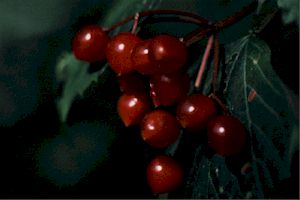
Opulus is a native of England, Scotland and America.
In this country it is found principally through the Western States. It
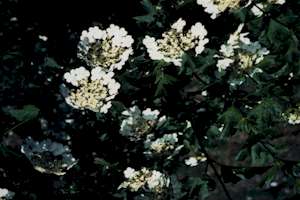
is commonly known as cramp bark, or the high cranberry. The common
snowball tree, found in most country gardens, is another variety of the
same species. Its flowers, however, from the effects of cultivation, are
sterile. For medicinal purposes a tincture of the fresh bark of both
root and branches is made with eighty p. c. alcohol. It is said to have
been used by the Indians for painful affections of women. It certainly
has been for years a favorite domestic remedy. About a year ago my
attention was called to the use of Viburnum
in dysmenorrhœa by an article in one of the journals, written by Dr.
Hale. At the time, I was treating a couple of cases, to which I
administered the drug with good effect. Since then I have given it to
more than twenty cases. In two of these cases only was the result a
decided failure. In one of the two I afterwards discovered a fibroid
tumor of the uterus, which prevented the introduction of the sound, and,
judging from the history of the cases caused the dysmenorrhœa. The
other girl, æt. 16, who began to menstruate when 12 years old, the
performance of the function always having been attended with exquisite
suffering. In this case the suffering, at each period has been mitigated
by Cimicifuga. A few of these cases have been completely relieved. Two
or three are worth mentioning.The first was a married
woman, æt. about 35, tall, large frame, dark hair, eyes and skin ;
scrofulous ; intermenstrual health excellent. Three or four days
previous to the appearance of the menses she complained of pain in the
back, gradually extending to the hypogastric region and down the
thighs ; headache, accompanied by nausea and weakness and bearing
down pains usually set in before the discharge appeared. This condition
would remain, in a more or less intense form, until severe days after
the flow had ceased. Menstrual periods regular, and normal in duration
and quantity. The dysmenorrhœa had continued a number of years. On
October 9, 1876, a few days previous to the time the pain usually
appeared, I gave her a box of pills saturated with Viburnum,
and ordered her to take one three times per day. I have seen her
frequently since, and she has repeatedly stated that her menstrual
period occasions her no more inconvenience than is natural. She had not
taken any other drug for two months before using with Viburnum,
and has taken none since, except one prescription of Causticum
for a cough.Another case was that
of a married woman. The symptoms were about the same as above related.
The patient was short, heavy set, light hair and eyes, and thick, white
skin æt, 25. She had suffered from dysmenorrhœa since girlhood. Viburnum.
Her next period was free from pain. In October the pain returned. She
then took Viburn. 3x for nearly a
month, three times per day, and has since continued free from distress.Another case was of a
different character. A girl, 17, tall, slender, dark hair and eyes,
thin, fair skin. Lived in the country. Had dysmenorrhœa from first
menstruation, two years previous. The pain was spasmodic, cramplike and
very severe, compelling her at times to go to bed. The digestive organs
were sympathetically affected. She suffered from congestive headache,
with flushed face and throbbing pains in the head. After each period she
was much prostrated, and complained of all sorts of sympathetic
ailments. Early last fall I sent her Viburn. with instructions to take
10 drops of the medicine with half a glass of water, and of that take
two teaspoonfuls three times a day. She continued the remedy about 3
weeks, and was entirely relieved.In several other cases
I have reason to suppose the drug has effected cures, but sufficient
time has not elapsed to be certain. Hale thinks that after three or four
months there is a tendency to a return of the trouble. In some cases I
have met with partial success, in several, whenever the Viburnum was
given a few days prior to the period, the latter would be free from
pain, but if the remedy was omitted, the symptoms could be as severe as
usual.
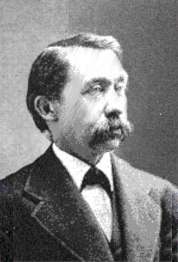
Dr Edwin M. HaleA number of physicians
have reported the successful use of Viburnum
opulus even in pseudo-membranous dysmenorrhœa. Prof. Hale
writes :“I have used the Viburnum
in many cases of neuralgic and spasmodic dysmenorrhœa, and have yet to
meet with a single case where it has failed to cure. So confident have
been in its almost marvelous power, that I have taken pains to look up
some old cases that I had dismissed years ago as incurable, in order to
test this new remedy on them. In every instance, so far, it has cured
these old obstinate cases.”When cases of reported
cures are examined, vast numbers of symptoms are found, but it is
difficult to determine which of them can be relied upon as
characteristics of the Viburnum. The
drug has never been proved, therefore the symptoms given in the books
are purely clinical. Like all unproved remedies, it is be-g indicated by
the failure of carefully selected remedies. Hale considers its range of
action almost identical with that of galvanism. It is probably best
adapted to the spasmodic and neuralgic varieties of dysmenorrhœa. The
most constant clinical symptom has been severe cramps. The cramp-like
pains in the uterus were present in nearly all cases in an intense form.
Cramps and constrictions were felt in the lower extremities. Even the
reflex symptoms were characterized by cramps. Among the symptoms
recorded we find cramplike difficulty of breathing, cramplike pains and
spasms of the stomach, bowels, bladder and other organs. One author
mentions the relief of paralytic conditions coming on after cramps and
convulsion due to uterine irritation. Hale mentions general irritation
of the nervous system from the same cause, and considers it a good
indication for the drug. The menses are usually regular, but scanty.My own experience with
the Viburnum is evidence of its
homœopathicity to a very large majority of cases of painful
menstruation, for I have not attempted to select cases. In the
dispensary I have given it, as an experiment, to case after case of
dysmenorrhœa, just as they appeared, without any attempt at
individualization, and the treatment has been so satisfactory that
within the past month sixteen new cases have been brought to me there by
persons who were relieved by the drug. I have never given it higher than
the 3x. Given in higher potencies its effects might possibly, in some
cases, prove more permanent.The Viburnum
prunifolinum, or black haw, is recommended more especially
for excessive labor pains, and to prevent threatened miscarriage.
DISCUSSION.
Dr. Hoffmann :
I have never
used the Viburnum. I think the first case would have been cured by Nux
vomica ; the cramp-like pains indicated this remedy.
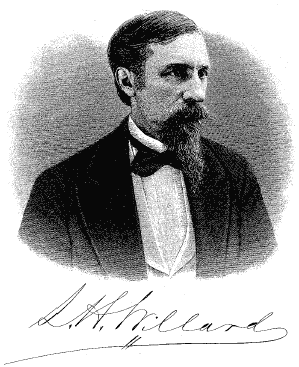
Dr L. H. WillardDr. Burgher :
I have used
the remedy in some cases and with success in a few instances, but always
preferred to use thoroughly proved drugs.
Dr. Cooper :
I have used it
with some success, but the results have not been sufficiently marked to
make it a first class remedy.
Dr. Willard :
I have never
used it, but think that what is already known of the remedy through
clinical experience is good enough to commence on. The remedy should be
proved, because the diseases for which it seems to be most useful are
very difficult to cure.
Dr. McClelland :
My
experience with the remedy is very limited. In one case very marked
relief followed its use. There are two kinds of Viburnum ; the one
is indicated when the flow is excessive, the other when the flow is
scanty. The particular indications for each can only be ascertained be
careful proving, and that while clinical observations alone may be to a
certain extent reliable, the proved remedies are better. Some authors
claim that one-half of all cases of dysmenorrhœa are obstructive, and
hence can only be cured by mechanical means. Now a case may be
obstructive, say from hyperæmia, and be cured by the properly selected
homœopathic remedy.
Dr. Chapman :
I have tried
Viburnum in a taw cases without any apparent benefit. There are so many
influences brought to bear on women at such times, that proper hygienic
instructions will be of great benefit and add greatly to a successful
cure. I use mostly Nux. vom., Puls., Xanthox., Cimicif., Colocynth and
Bell. Women are usually very nervous and anxious, and frequently do many
things that they ought not to do.
Dr J. H.
McClellandDr. Burgher :
There is no
specific for dysmenorrhœa. One proved remedy has not been mentioned,
the Lilium tig.
Dr. King :
I think that most
cases of obstructive dysmenorrhœa are due to hyperæmia or to some
spasmodic action, and that Viburnum will relieve most of these cases.
Dr. Cooper :
In one of the
most distressing cases of dysmenorrhœa that I have ever seen, speedily
relief was obtained by using electricity. While Phos is claimed as never
a specific for membranous dysmenorrhœa than any other remedy, I have
cured a case with Nitric add. In such cases I try to cure the
intermenstrual symptoms.
Dr. McClelland :
I depend on
Chamomilla for relief in most cases than with any other single remedy, I
never give it lower than 12th.
Source :
Hahnemannian Monthly, 1877.
Copyright © Sylvain
Cazalet 2001