The development and
formation of the repertory.
By James Tyler Kent
Presented by Sylvain Cazalet
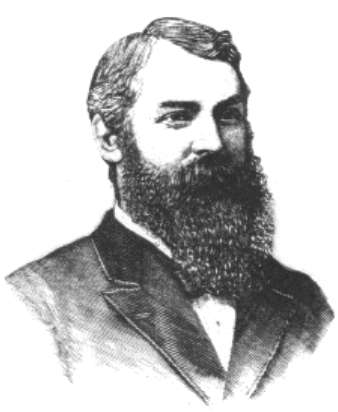
Dr J. T. Kent
THE EARLY REPERTORIES.
Not so many years after
I was first a homœopath, there fall into my hands the first
Bœnninghausen’s Repertory, Lippe’s “Repertory, Biegler’s Diary,
Minton’s Diseases of Women, and Jahr’s Repertory, which in form was very
good. And Lippe’s Repertory, in characteristics and form was very good.I carried Lippe’s
Repertory with me for a number of years, until it was not only
interleaved but doubly and trebly interleaved, the pages so closely
written upon that it was impossible to find what I had written into it ;
so that ended in confusion. But this was the one upon which my earlier
reliance rested.Then came the time,
when I began to teach Materia Medica, in 1883, when I could readily see
that we ought to have more.
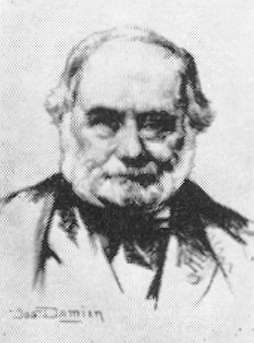
Dr T.F. AllenThe Symptom-Register
(Allen’s great Encyclopædia), was so limited that it lacked half of the
symptoms.Jahr’s Repertory was
placed next in importance because it was a repertory of the grand old
remedies, It was very good for these, but our pathogenesis had increased
so much that it was no longer a satisfactory work ; it did not fill
the requirements of my practice. So I began taking up these works and
effecting a compilation.Eventually I had a
large manuscript of most of the repertory. I talked with Lee, of
Philadelphia, as Lippe’s abridged form of a new repertory was in his
hands and Lippe desired me to enter upon the work of helping or uniting
with Lee to produce a complete repertory.At that time I had
completed a Repertory of the Urinary Organs, of Chill, Fever and Sweat,
with other sections partly complete.Lee went to work and
got out Mind, and later I helped him to get out Head, but they were very
incongruous. The modalities in each rubric in Mind were given at the end
of the book, and later the modalities of Head and the Generalities were
placed at the end of the book. This was done in accordance ? with
the understanding of Bœnninghausen’s ideas of Generals.
BŒNNINGHAUSEN’S REPERTORY.
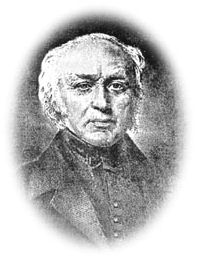
Dr C.
von BœnninghausenThe chief difficulty
with Bœnninghausen’s Repertory was that the modalities of the parts and
those of the patient himself were all mixed together, so that the book
was very unsatisfactory. I did not use it successfully. It was the best
thing that we had given to us, but it was not equal to Jahr’s old
repertory.Bœnninghausen’s first
idea was that the modalities were satisfactorily arranged in connection
with the symptoms to which they belonged. He finally, put out that
condensed form, the Pocket-Book. This, to my mind, was not properly
Homœopathy ; but some of the doctors were able to use it. They
would grasp the idea, and of course the book was better than no
repertory. I always used it, for there were times when I could find
something in it from which to work out, when I could not find the
modalities belonging to the symptom itself, separate from the Generals.We found it to be very
unwise for us to think of a patient worse from
lying down confounded with the modality of all the
particulars throughout the book, whether headache, pain in the eyes,
pain in the back, difficulty in breathing, pain in the stomach after
eating, not specifying whether the modality referred to this, that or
the other thing, or whether it was the patient himself. When we really
stop to think it over, we know we ought to have the general aggravation
or amelioration by lying down set in one place with its causes, apart
from all else. The entire Bœnninghausen book is arranged with
modalities, general and particular, all together. Those of us who have
used better things see how it was as it fell into my hands ; yet
with many good things in it.Bœnninghausen was a
grand old man, but that was simply his idea and it was defective for my
method of practice ; because I soon grasped the idea that Hahnemann
considered the mental symptoms and the physical symptoms. He (Bœnninghausen)
took the patient himself ; because he said, the patient has
modalities that are related to the patient himself and other modalities
that are related to each of his individual part by itself-put them
together, and let them come out as they will.In a short time I saw
that the plan started upon by Lee was not what I had expected it to
be ; I told him so, and abandoned my effort to help him improve the
repertory. Then he became nearly blind, of both eyes, and said that his
health was nearly ruined, that he could not go on with the work, and
would have to give it up.Taking up what had been
started, I then revised it thoroughly and formed it according to my own
plan, which you now have in my repertory.
Dr G. H. D. Jahr
Dr A. Lippe
A COMPILATION.
This is a compilation
of all the repertories, so far as I was able to make it, upon the plan
which I arranged and adopted. The plan followed chiefly Lippe’s as shown
in his small Hand-Book of Characteristics, gradually enlarging upon that
work until it became what it was when the first fascicles were
completed.After that, I took up
the clinical symptoms which I had recorded, and compared them with the
provings as I had them ; very many of them were contradictory, of
the provings, and so were rejected. Those that were consistent with the
provings I admitted to the repertory, setting them into the various
passages where they belonged.A section in
typewritten form was by that time several inches in thickness. That
typewritten form was gone over many-many times ; so many times,
because as the compilation continued, things kept coming up that were
bound to be more and more effective, and we were constantly modifying
the provings, including in the provings such symptoms as were found
verified.At one time Dr.
Biegler, of Rochester, was in, my office, looking over the pages, and
some of the Boston doctors conning to me in Philadelphia wanted to look
it over ; they said : “Why can’t we have this
repertory ?” I said, “Because it will cost too much
money”. I have not made it for publication, but for myself, for my
own use. It was made because of the demands of my business, and is the
outgrowth simply of my own personal requirements. But I am willing that
every body should have it.
PUBLICATION AND COST.
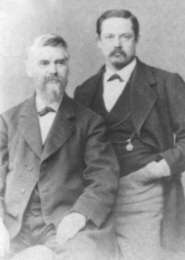
Drs Boericke
& TafelThen they insisted upon
my making some plan for the publication of it, and Drs. Kimball,
Thurston and Biegler sent out circulars to see, if they could secure
enough subscribers to justify the publication. I consulted Dr. Boericke,
president of Boericke and Tafel, and showed him the manuscript. He
said : “It is a great and useful thing. I wish we had
it ; but it will cost too much money to publish, and was could not
undertake it”. The first figure that I obtained was about $ 9,000
for the mere printing. I did not feel like throwing away so much money.
As I had talked it over with several other doctors, I did not believe
there ware more than three or four hundred, at the out side, who would
have use for the work, or would want it.The circulars brought
in a subscription list of between one hundred and ninety arid two
hundred, not more than two hundred, at $ 30 per copy. So I concluded
that I would meet the rest of the expense and get it out, with hope that
it might prove useful to the world.So it was issued,
section by section. When the second section was out, I was notified by
all except ninety of the original subscribers that, as the book was not
what they expected to have, I might cancel their subscriptions. Ninety
stuck to their pledges and their signatures and took the repertory.Well, things went on
from bad to better-not to worse-and-the Repertory was born, with much
suffering in eyes and heads and bodies of both myself and my wife,-but
of this you need not hear at length.The book is now very
extensively used, to the number of about 1.600 copies, through out the
world, in India, England, the United States, a few in Germany, quite a
number in France and also in Australia.It is, of course, a
compilation ; I did not manufacture the symptoms, but wrote them
the best way I knew.I do not know how there
will ever be a third edition ; neither myself nor my wife could
read the proof, and I do not know who would. There are still over four
hundred copies of the second edition unsold, and I am quite well
satisfied that at least 60 per cent of those who use this repertory will
never wear theirs out and need to replace them.Dr. Thacher ; I
have the proud distinction of being the possessor of the first signed
copy of the Repertory, of the first edition. I went over to Dr. Kent’s
office by chance one night, when some of the copies had just come in
from the printer, and he asked me what I thought of it. I said it was
great ; I should like to have one ; how much was it ?
“Thirty dollars” made me hold my breath, but when I looked
through it again I thought I could not do without it for thirty times
that sum, and said : “I will take that”. The doctor said
“George, that is the first one that has been sold”. “All
right” said I, “put your signature on it. I will take it right
with me”. No one can buy that Repertory.James Tyler Kent, A. M., M. D.,
Chicago, Ill.
Source :
Homœopathicians,
July-August, 1914.Copyright © Sylvain
Cazalet 2001