Do Medicines Make
Functional Changes?
By E. A. Farrington,
M.D.
Presented by Sylvain CazaletAt a regular monthly meeting of the Society held on May 11th,
1876, A.R. Thomas, M.D., President, being in the Chair, the following
interesting papers were read by E.A. Farrington, M.D.; “Do
medicines make functional changes?” being a reply to an article
of Dr. Lippe in the May number of the Medical Advance, entitled,
“The Last Departure of Homoeopathy in the Physiological
Livery,” and by Pemberton Dudley, M.D., “On the Cimex
Question.”
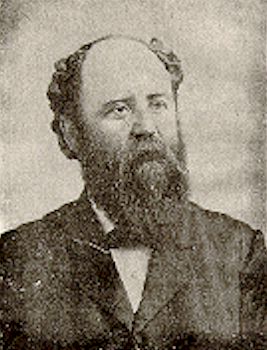
Dr Pemberton DUDLEY
1837-1907In the May number of the Medical Advance, Dr. Lippe contributed
an article entitled, “The Last Departure of Homoeopathy in the
Physiological Livery.”So far as the charges preferred in this article apply to me personally,
they demand no reply. But so far as they compromise the integrity of the
College in which I hold my professorship, I am bound to enter the
contest in her defense.In the early part of the winter I issued a syllabus containing some
questions, arranged in sections. These questions comprised a goodly
portion of the Materia Medica, certainly such portions as the beginning
practitioner aught to thoroughly understand before he commences the
practice of medicine.To this syllabus Dr. Lippe raises several objections, viz.:
– first, he considers that it
reaches Schusslerism; secondly, that
it is contrary to the teachings of Hahnemann; thirdly,
that it is false because the answers to many of the proposed questions
are impossible – cannot be true.The words which seem especially obnoxious to him are these: “The
intelligent application of Materia Medica requires a knowledge of the
changes medicines make in functions and nutrition.” For example, I
asked, “What changes does Lachesis make in the blood?” This
Dr. Lippe terms Schusslerism. He asserts, and misapplies Hahnemann to
confirm his argument, that it is impossible to know what changes
medicines make in function and nutrition.The reply to his argument comprises three questions:
First, what is
Schusslerism?Secondly, can we learn
what changes medicines make in function and nutrition?Thirdly, if he can, of
what use is such information in the application of drugs?
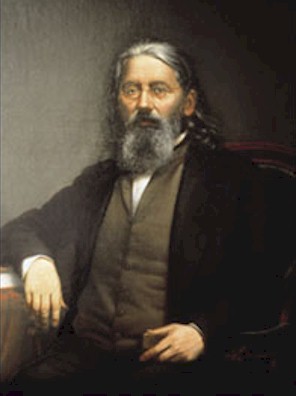
Ernest Albert FARRINGTON
(1847-1885)
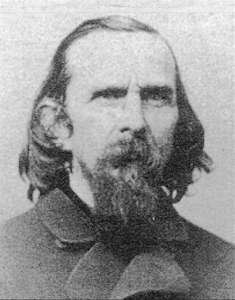
Constantine HERING
(1800-1880)First, if Schusslerism means the law which Dr.
Hering discovered some thirty years ago, then I plead
guilty to the charge. If it means floundering about with untried
remedies, basing their symptomatology on their supposed physiological
action, making a cure all of twelve substances – then I most
emphatically deny the charge. Every question propounded in the syllabus
is answered either from provings or from clinical experience. If
Schusslerism means that medicinal substances act on tissues producing
changes in function and nutrition, then again must I plead guilty.And this brings us to the second question, upon the solution of which
depends the maintencance of my position. A function is, literally, an
act, a performance, and applied to physiology, “is the action of an
organ or set of organs” (Dunglison). If I take a drug and symptoms
result, are not these the expression of altered functions – altered in
degree or quality? If, for instance, Lachesis
causes hemorrhages with a settling like charred straw (Guernsey),
or if it causes profuse bleeding, the blood will not coagulate (Lippe);
is this not a nutritive change? And will this altered blood perform its
normal functions? Let the answer be found in ghe gangrene, the
erysipelas, or the impending typhoid state.
Henry Newell GUERNSEY
(1817-1885)
Adolph von zur LIPPE
(1812-1888)Were Dr. Lippe to ask how are the changes made, I would be compelled to
answer, I know not. The secret workings of vital force are under
infinite surveilance. Just how it works, mortal man may never know. We
live in a world of effects, and it is only of these we can become
cognizant.The blood propelled by the heart, sweeps over the aortic arch and down
the aorta, never dispensing its gifts until it reaches its ultimata in
the capillaries. Nerves run to and from centres, giving no impressions
until their termini are reached. The ulna, irritated at the elbow,
tingles at its termination in the little and outer side of ring fingers.
So with every vital effort, it is in its fulness only when terminated in
its appointed organ or organs.Organs are made of tissues, tissues of molecules, and herein are
consummated the complex vital phenomena which make up life. As Hahnemann
says, the internal changes we cannot determine. But their effects, which
appear normally in conscious sensation and motion, and abnormally in
symptoms, are determinable. Whether these symptoms are subjective or
objective, they express a change in function or nutrition, and bespeak
the tissue or tissues involved.If a function is truly defined above, will not the symptoms show a
changed “action of an organ or set of organs?”If I take a remedy, say Rhus,
and it produces a vesicular eruption, will it be denied that a change in
nutrition has taken place? And cannot we perceive what change has taken
place? Or, still more to the point, if for a non-uniting fracture we
prescribe Calcarea Phos., and
the callus quickly forms – a callus containing a hundred-fold more lime
than we give – can we denly a tissue and a nutritive action?We know that tearing, boring pains indicate an affection of bones or
periosteum; that sharp, shooting pains indicate an affection of serous
membranes. We know that Aconite
acts on serous sacs, increasing their suction; while Sepia,
Iodine, etc., relax serous and synovial sacs.Equally sure are we that Hypericum
acts on nerve tissue, Arnica
on the capillaries, Mercury
in the production and Silicia
in the prevention of pus formation, Conium
on adenoid tissue, Graphites
in the dissolution of cicatricial tissue, Creosote on the
mucous lining of the stomach, Silicia,
Chamomilla, Bryonia, on connective tissue, Ferrum
on the haematin, Phosphorus
on the blood cells, and so on through the Materia Medica.But thirdly, Are such facts of use in the application of materia medica?
True, a physician may cure the Lachesis
hemorrhage without any other information than the mere words of the
symptoms. But so long as man finds delight in the exercise of his
God-given reason, he will demand the why
– the why which anticipates every new truth – the why which led to
Hahnemann’s quinine experiments, and to every succeeding step in his
discovery of Homoeopathy.No physician can intelligently apply medicines with simpley a memorized
materia medica. He is then like the industrious student who, in his
attempt to learn French, memorized the dictionary but learned nothing of
grammatical construction. Neither can the physician always succeed in
obtaining the necessary totality of symptoms without an intimate
knowledge of functional perversions. He must know from physiology what
are the normal relations of organ with organ; from pathology what
changes diseases cause; from the history of diseases what are their
probable course, duration and result. For example, delirium, photomania,
singing, praying, making verses, will yield to Stramonium;
but the same symptoms with retained placenta, demand Secale.
Neuralgia in and over the left eye may yield to Spigelia,
but if a tilted uterus exist, even though there are no subjective pelvic
symptoms, the remedy will be Actea Rac.
*
Gustav W. GROSS (1794-1847)Gross in his
“Comparative Materia Medica,” gives as a symptom of Apis,
“suppurations do not occur.” Why? Virchow tell us that the
production of pus demands an inflammation of the parenchyma. Apis
only attacks surfaces, hence it seldom forms pus. The utility of this
characteristic is evident in contrasting the remedy with Belladonna,
which does attack the parenchyma; Apis,
tonsils bright red, erysipelatous; Belladonna,
tonsils bright red, swollen threatening suppuration.If a patient passes urine depositing a reddish sand, are we damaging
Homoeopathy if we search for the cause of this defective oxygenation of
nitrogenous matter? On the contrary, will not the revealed symptoms help
to complete the totality, and so help us to diagnose between Lycopod.,
Natrum Mur., Ant. Crud., etc., all of which have such a
urinary deposit?If a newly proved drug causes white, flocculent urine, are we violating
the precepts of the Master if we analyze this excretion and, finding
phosphates in excess trace thence the relation of other symptoms
produced? Let it be remembered, however, that symptoms have a relative
value; and although we may make use of every known means in analyzing a
case and collecting the totality of its symptoms, we must arrange our
picture according to the well tried rules of the Organon.The true physician, while he holds fast to the precepts of Hahnemann,
neglects no fact which a progressive science might utilize, no discovery
which bears the stamp to truth. If the new discovery contradicts his
well confirmed laws – his creed it may be called – it must be false, for
truth cannot invalidate truth.Dr Ernest Albert
FARRINGTON
1876Copyright © Sylvain
Cazalet 1999