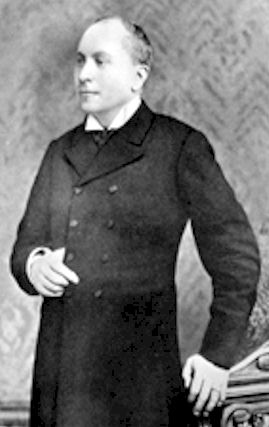
CANCER AND CANCER SYMPTOMS
by Robert Thomas COOPER
Presented by Sylvain Cazalet
Dr Robert Thomas COOPER
(1844-1903)
Arborivital Medicine
Arborivital Medicine: its meaning. The
necessity for investigating action of Single Doses. Remedies act over a long period of time.
Special preparation of plant-remedies not absolutely necessary. Medical Education not in
accordance with Nature. The Cancers easily acted on; explanation. Illustrative Case. Cancer
contrasted with Chronic Deafness and other Chronic Disease. Case of Hodgkin’s Disease:
lessons to be learned from it.IN a series of papers published in the
Hahnemannian Monthly of Philadelphia, I sketched out a system for the better investigation
of medicinal substances, and particularly of plant- remedies, to which I gave the name
Arborivital Medicine.The idea underlying the proposal is, that
if it is required to discover the actions of plant-remedies and their influence upon chronic
forms of disease, it is absolutely necessary that we start de novo, and investigate the
action of Arborivital Medicine. Hahnemann, it is well known, claimed for his special
preparations of remedies, mineral as well as Hahnemann’s own wording on the subject is, I
admit, not very clear, and a lengthy discussion on the subject would be undesirable.My contention, in a word, is this, that in
the living plants we get a force which, if applied in accordance with the laws of Life to
disease, will arrest its progress, and even cause its dispersal. Further, that while
artificial preparations, vegetable substances, a property of lingering in the human body and
continuing to act for a much longer time than had previously been suspected. Such a power he
claimed fdilutions, and triturations are required for the better demonstration of such a
force in mineral substances, they are not required for proving the existence of a like force
in plant-remedies. To this force I gave the name arborivital, and the action that results
therefrom Arborivital Action.I do not hesitate to affirm that the whole
state of medical education is in every way unnatural, and that this accounts for the fact
that little or nothing is known of the action of our commonest plants by men supposed to be
our foremost medical practitioners; and I further state that some of the most easily acted
upon forms of chronic disease, such as are the cancers, have for this reason remained, at
this enlightened age, upon the list of uncured and incurable diseases. The curriculum of
education adopted for the practitioner of medicine is more absurd than the public imagines.
Or his dilutions and triturations, but he did not claim, or if he did, none of his followers
have since his time claimed, that substances possess any such power apart from these
artificial preparations. In former days the young student had some chance of familiarising
himself at staring with the practical work of his profession, for he became an apprentice of
assistant to an experienced practitioner and had an opportunity of seeing what were the
every day duties of a working member of the craft.Now this is all changed; the student is
debarred by the Medical Council from doing any kind of work until he is qualified.In order to be qualified he has to keep
studying anatomy and materia medica for two years before he is allowed to feel a pulse, look
at a tongue, or give a dose of medicine.At the end of these two years, and before
he has yet looked at a patient, he is examined in what ? in materia medica; in other words,
in the actions and doses of medicines. Doses did I say ? yes, the doses, i.e., the largest
amount of medicine that can be given short of poisoning the patient.If the diligent youngster dares to suggest
anything above or below this standard, he is forthwith relegated to his studies; to the
enrichment of the Conjoint Board, and the abolition in himself of all sense of the fitness
of things.A still worse fate, however, attends the
aspirant to a knowledge of Homoeopathy. Having devoted five or six years of the best portion
of the thirty years of his probable professional life to an indoctrination into the
mysteries of allopathy and having been declared by august qualifying bodies to be endowed
with knowledge sufficient to deal with the responsibilities necessarily attendant upon the
treatment of disease, not a single case of which he has ever treated, he can then, but not
till then, avail himself of private judgment and make inquiry into advanced medicine.Here, however, any little pride he might
feel in having successfully acquitted himself, so far, in his professional career, is
destined to receive a rude shock.
No
sooner does he enter as a student at the London Homoeopathic
Hospital, than the information is vouchsafed him that within these sacred
precincts, no tongue must be looked at, or pulse felt by any other than a Member of the
British Homoeopathic Society; belief must come before conviction and must rest upon the
evidence of things not seen. And this is the method adopted by a reforming body to secure
the enlightenment of the coming generation in the system of Hahnemann. Our special wonder
may well be excited at such things as these ! Nothing is more common than to hear old
experience medical men verse that they do not believe in the actions of medicines.Considering that these very men have been
filling the systems of suffering human beings all their lives with medicines, it is rather
too much of an absurdity.If these same medical men had been put on
to investigate the action of our common plants, and restricted in their prescriptions to
single doses and to chronic and non-urgent cases of disease, I do not hesitate to say they
would either, and rightly so, have been in the early days of their career stopped from
proceeding further, or would have given evidence of their fitness for their profession by
making valuable observations. The real fact is that the investigation of our plant-remedies
is extremely simple and free from risk, if we but confine ourselves extremely simple and
free from risk, if we but confine ourselves to single doses and to chronic forms of disease.Moreover, it is also to fact that the most
easily acted upon of all forms of chronic diseases are, as just hinted at, the tumours,
especially internal ones, whether cancerous or otherwise. It is the object of this pamphlet
to support these last two propositions.Before going further let me illustrate this
assertion that the internal cancerous tumours can be easily acted on.A lady asked me if I would take up the case
of a poor woman suffering from cancer, in whom the right kidney had been removed some
eighteen months before, and in whom the cancer had broken out again at the site of the
operation and around the bladder.Without seeing the patient, and from my
experience in such cases, I replied that in all probability there was a great deal of
cancerous growth present, and that if so, the likelihood was in favour of its being easily
acted on, and consequently, that the disease would give out almost immediately she took a
dose of the indicated remedy. The patient, therefore, I went on to say, will probably be
frightened, and discontinue treatment.The lady’s reply was significant:
“There is not the slightest fear of the poor woman being frightened, for she is now
under the influence of morphia, and is entirely despaired of by all the doctors who have
seen her.” On February, 10, 1899, I sent her a dose of a very simple remedy the saffron
crocus and on the 14th her daughter came to met to know what was to be done, as her mother,
though constipated previously, had next day after the dose, broken out into the most violent
diarrhoea; even her food passed through her at once, and she felt fearfully depressed and
low.Recognising the fact that all this was to
be fully explained by the out-pouring of the disease, I simply advised copious draughts of
very hot water in sips, and the discontinuance as far as possible of the morphia she had
been taking.It is such evidence as this in numbers of
cases that entirely justifies me in saying that the internal cancers admit of more
satisfactory proof of being acted upon by internal medication than any forms of chronic
disease. Take, for example, a chronic deafness vascular deafness, The terms applied by the
Author to the most usual form of Chronic Deafness, the initial lesion of which is a diffused
vasculitis and the consequence, the thickening and stiffening of the Mucous Membrane (of
Toynbee), or the Proliferous Catarrh (of Roosa). Vide “Vascular Deafness,”
Bailliere, Tindall and Cox, London, 1886 or a chronic psoriasis, or long-lasting skin
affection, it is not possible in any varieties of these affections to demonstrate so
satisfactorily to either patient or doctor that the internal medicine is in operation, as
was done in the above instance.In all varieties of chronic disease the
same force may be thrown into the system, and may begin working from the first, yet the
evidence of its activity is t once apparent in the cancers, and it may be demonstrable in
the others for weeks, or even months. And is this unreasonable? In such a condition as
cancerous tumours we get myriads of germs accumulated in one part of the body, the inference
being that Nature, always conservative, protects and prolongs the life of the individual by
causing these germs to collect in one region, rather than allow the poisonous dissemination
throughout the various structures of the human body. If this be the case, the effect of the
indicated remedy will be proportionate to the size of the accumulated mass and the ease with
which it can be acted on.If, then, the ignorant and superstitious
idea obtains that there must be some proportion between the amount of disease material and
the size and virulence of the dispersing agent, any attempt at curing the disease is simply
hopeless. For is it not evident that if a large quantity of such a substance is necessarily
associated with a proportionate amount of force, such force, if in relationship with the
disease, will be so great as to cause a rapid giving way of diseased tissue and will thus
tend to poison the patient? While if, in such a case as the above, the doses, though small
are too frequently repeated, the effect will be the same, and the too rapid dispersal of the
diseased material will act as a poison not alone to the life of the adjoining tissues but to
that of the patient thus rapidly infected?That medicines simple plant-remedies can
thus influence these forms of disease is not a matter of mere theory; my knowledge of it is
evolved from deliberate clinical observation extending over more than thirty years. The
matter is simply one of relationship, it is not a matter of quantity of material.The seed of a globe turnip (Brassica Rapa)
is said to multiply its bulk in the ground seventeen million of times, the resulting effect
being in no way due to the size of the original seed but to relationship that exists between
the soil and the germ or seed placed there.In the case of cancer referred to, the
evidence is almost as it is that the turnip resulted from the originating seed. The power is
manifest, it is strong, and science having obtained such a power ought to find means to make
it efficient efficient, that is, for curative purposes.Were there no evidence forthcoming but that
furnished the above case, it alone would prove the preliminary statement that the cancers,
and especially the internal ones, can easily be acted on.But can this Force, so powerful in
disturbing a disease mass, be utilised for curative purposes ? In the case referred to, an
immense carcinomatous mass extended from close below the liver down to the pelvis of the
right side, and at the site of operation this pointed and threatened to ulcerate. A patient
whose body is so full of cancerous material, and with but a single kidney left after the
operator has done his work, is not under any circumstances likely to recover; but that she
is being acted upon, and acted upon beneficially, is evident from the pains having changed
in character and severity from stabbing, shooting pains to dull and dragging ones and from
the fact that the patient no longer requires morphia for her pains, and is having sufficient
sleep. Though, as I write, a fortnight has elapsed since this patient took a dose of a very
simple remedy, Juniper comm., given in consequences of the Polyuria that existed before the
cancer was detected, her entreaty is not to be given another yet awhile; and she is
perfectly right. The action started is a beneficial one, but it is attended with greater
changed than the poor patient can comfortably endure. Its violence must be allowed to tone
down before a repetition of such effects can be safely endured.The subsequent course of the
disease was characteristic. The patient went on very well and free frompain until on 3rd
September I gave her a dose of silphium perfoliatum. At the time of taking it she had been
getting on very fairly, the swelling, which had threatened to press up dangerously against
the chest, had lessened; and the condition might have been regarded as one of remarkable
quiescence, no change taking place either way.Immediately after the dose a gnawing pain
in the swelling set in and the bowels became confined, and the scar left by the eviscerated
kidney began irritating and in four or five days discharge was noticed. This discharge
continued to increase till a large opening formed, from which a profuse clear fluid went on
pouring away night and day, from the end of September to 11th December following. on the
night of 10th December she was so free from pain and suffering that her daughter, who had
attended her assiduously all through, left with every expectoration that her mother’s rest
would be undisturbed. However, in the early morning (about 2 a.m.) sinking set in, and in
about an hour she passed away peaceably and happily and without a particle of pain.What is the meaning of all this? The
meaning of it is, that the vital powers had become exhausted by the draining away of the
disease, an out-pouring having been effected by the unit dose of silphium given 3rd
September. This out-pouring would have been curative had the amount of cancerous material
been less in quantity; that it was undoubtedly natural, is proved by the absence of pain,
the shrinkage of the cancerous mass, which was very obvious, and the general improvement in
the patient’s condition during its continuance. In other words, the evidence in favour of
there being in operation a form of activity other than the activity of the cancer force
itself, subsequently to the exhibition of the indicated remedy, is as conclusive as anything
can be in such matters. That heaped up disease, in the form of cancerous mass, can be set
free by the action of remedies, is placed, in my opinion, almost beyond dispute by the case
of a lady, aged 54, the left side of whose neck was one great mass of cancerous glands a
truly malignant form of Hodgkin’s disease. Three months before seeing me this patient had
presented herself at Charing Cross Hospital, where he case was very properly declared
hopeless, and an operation refused. In the meantime the disease had much extended, and when
I saw her, masses of cancerous material existed on the right side of nape of neck, as well
as those on the side and below the collar bone on the left. On january 5, I prescribed a
unit dose and an ointment of scrophularia nodosa, and on the 19th following had in a report
that a diffused rash, looking like that of measles, had spread over the body and face
immediately after taking my medicine, and that otherwise she had improved; the phlegm coming
up in the throat was less and the bowels were more regular. Ruta graveolens in unit dose and
ointment was then given, and on February 2 following, she was reported as feeling much
better and could swallow better. The swellings, though the same in size, had become tender
to the touch.Now, my inference from all this was that
the patient had been strongly acted upon, as shown in the first interval by this
“measles” eruption, and in the second interval by the tenderness of the swellings,
and throughout both intervals by the general improvement in the patient’s feelings. My
advice, therefore, was to absolutely discontinue all medicines, as I felt sure a force was
acting upon the swellings, and that she ran the risk of having the disease set free too
quickly. This was proved to my mind most unmistakably by the subsequent progress.On February 14 report came in that for
three days there had been great difficulty in breathing and in swallowing, and to this my
remedies, and that the patient was simply to sip constantly of lemon juice and hot water.In about three weeks afterwards I was
forwarded, by two messengers well acquainted with the deceased, a flurried letter, written
by her daughter, to the effect that they had left the patient only too long without
medicine, and that by the time a doctor was called in mortification had set in, and that the
poor patient had died that morning. It was obvious from the tone of the letter that a rival
practitioner had been making disparaging remarks, as sometimes happens. But this did not
prevent my putting some questions to the bearers of this unhappy intelligence.Firstly I asked, “Did the patient die
in pain ?” Reply,”Oh no ! not in the least.” ” And where, may I ask was
the mortification ?” Reply, ” Across the loins; the parts turned quite black she
reply was that I could not sanction the giving of ordinary ent entirely away; there was not
a vestige to be seen of them before she died.” ” Well, then,” I said, ”
can you not see what took place ? The medicines acted on the disease and acted beneficially,
but the diseased material being in such large quantity, and discharging itself as it did
through the system, an undue amount of poison was thrown upon the chief emunctories, the
kidneys, and these, unable to bear the strain, mortified, together with the adjoining
structures, hence the blackened appearance of the loins. This only shows the extreme
naturalness of the process in operation, the patient going out of the world in a condition
perfectly painless and in her senses, not in terrific agony, only subduable by obliteration
of sensation by morphia.”Let, then, there be no mistake about the
pronouncement made. Cancer-tissue, when accumulated in any one part of the body, can,
generally speaking, be easily acted upon, much more easily then even a fatty tumour or a
tuberculous mass; the effect of remedies ought to be carefully watched, so as to prevent a
too rapid dislodgment of the disease; under any circumstances there is great danger to the
patient’s life if the cancer mass be large, by the too rapid outpouring of the cancer
poison; nothing contributes to this rapidity of flow so much as the constant repetition of
remedies; and, therefore, by far the safest plan is to allow a single dose to expend itself
upon the disease, and to be careful not to interpose even such apparently harmless things as
ointments, lest the effect upon the disease should be too great.Of course, these remarks apply to remedies
indicated by reason of their symptomatic relationship to the disease, and to forms of the
disease that are in a fairly plastic condition, and not like some osteoid cancers inactive
and unyielding.
Life in Cancer
Life in Cancer alike to other forms of
Life. The indicated remedy must be found; general hints for finding it. The prescriber
compared to a gardener. Case of Cancer of Pylorus that had been unsuccessfully operated on.THE matter, then, is one of sympathetic
relationship; the life of a collection of cancer cells obeys the same laws as the life of
any other living body. It has come into being by a process of germination and it is to be
dispersed by a force that sets agoing a similar but antagonising process. The difficulty of
cure lies in the difficulty in discovering the sympathetic force.But just as the experienced gardener knows
the conditions that are most favourable for development of the energies of certain seed, so
ought the experienced practitioner to know the conditions that in the diseases patient will
call into activity the curative energies of his remedy.The consideration of this aspect of the
question is likely to lead to much that is controverted; it will suffice to say that I have
met with very little difficulty in this particular class of diseases in arriving at the
indicated remedies.In this regard I have not allowed myself to
be swayed by the teachings of the high dilutionists of the Homoeopathic School,or by the
teachings of those who contend that some special symptom should constitute a key-note and
that this should be our guide to the selection of the remedy; nor have I been guided by the
more modern and material school, who insist that the curative dose should correspond in size
with the pathogenic dose, and that no remedy can be relied on as a curative unless it has
produced the actual disease for which it is prescribed.On the contrary, I take into consideration
all the bearings both of the disease tendencies and of the symptoms past and present, and in
accordance with these I select my remedy.Thus, in the case of abdominal cancer
referred to, I learned before prescribing that the period came dark and in clotted lumps,
that she had had a sensation of something moving inside the abdomen, with a livid complexion
changing now and then to yellow, and a general feeling of pressure in the abdomen, with
weighty feeling towards the womb; these, added to my general experience with the effects of
this particular remedy, led me to Crocus Sativus.But it is impossible to dwell on such
particular for very long; they would by themselves fill a volume.The physician prescribing for such cases as
these may well be compared with the experienced gardener who bases his selection of the
suitable soil for particular seeds upon a general experience, much of which it is impossible
to communicate by word of mouth.It is easy for the gardener to state the
plain fact of having chosen a particular soil and a special season for any given seed, but
he can do little more than this; he has probably forgotten the many little experiences that
from time to time influenced him it may be unconsciously in his determination. His
advantages over the doctor largely resided in the fact the from boyhood he has been in the
habit of gardening; the doctor has never prescribed until he theoretically knew much, and
practically knew nothing; until, in fact, the best part of his life was lost in acquiring
the crudest theories of the actions of medicines.To go on to actual experience. Take this
case of CANCER OF THE PYLORUS, Geo. A. Murrell, aged 40,
first seen by me July 22, 1898.History. Fifteen or eighteen years subject
to dyspeptic pains, and twelve years ago strained himself lifting a kitchen range; felt the
strain severely below the chest, and dates his suffering from then, though even before this
was dyspeptic. Was treated in the Heart Hospital under Dr., after having been an out-patient
for six months previously. Here his heart was pronounced affected, with old pleuritic sounds
down left side, along with ulceration of the stomach. Then as out-patient (he was discharged
from Hospital end of October, 1896) was again treated, chiefly with electricity.In the middle of January, 1898, severe pain
set in between the liver and stomach and he went into West minister Hospital, the diagnosis
being neuralgia of the stomach from gastric catarrh. Was discharged unrelieved; and was then
seen by several other physicians, and in March was advised to go into the Cancer Hospital,
Brompton, where he was operated on; the statement made to him after the operation being that
adhesions had been found between the stomach and thoracic wall, with a cancerous growth and
thickening of the pyloric, extremity of the duodenum, and that it was impossible to remove
all the diseased tissue. Some temporary relief followed upon the operation, and he was
discharged from the hospital under promise of his returning of pain reappeared.The patient from whom these particulars are
gathered, writes to me that ” The Cancer Hospital also arranged with Dr. D., a French
specialist, to come over (to the Hospital) and I (the patient) consented to another
operation under him; but when my case was fully explained to him he went back (to France)
without doing anything, as I understood he could not do me any good.” This was after
having obtained re-admission to the hospital owing to the return of his agonising pains.
After being six weeks in hospital on this second occasion he returned home, and was assured
by his own doctor that everything possible had been done for him, and that he could not
possibly live long, and that he must bear the pain while life lasted.The copy of his doctor’s certificates is in
my possession, dated July 19, in which it is stated that the patient “is totally unable
to follow any employment.” Referred to in the Prefatory Notice.The case,. therefore admits of no doubt as
to its nature or as to its severity.I first saw him on the evening of July 22,
1898; he was then writhing in agony on his bed, and could keep nothing long on his stomach;
warm foods relieved, cold drinks aggravated.The pains were worse at night, and began in
the stomach, spreading from there to the heart and between the shoulders, as if an iron back
were being forced through the stomach and chest. The patient felt the growth to be rapidly
enlarging, and pointed to the visible bulging underneath there attachment of the diaphragm,
where there is marked dullness on percussion, the bulging extending to scrobiculus cordis.
His tongue is red and coated towards the back, bowels confined, though sometimes has
diarrhoea.His family history is good, except that his
father died at the age of 73 of gastric ulceration.On July 27 he wrote that he had had
terrible pains on Saturday the 23rd, and had vomited twice; at 6 o’clock, p.m., of this day
had taken a unit dose of Ornithogalum Umbellatum, and afterwards reported that it was
followed by great pains, he felt almost frantic at 3 a.m. and again at 1 p.m. when the
bowels acted. At 3 a.m. he began taking 3 grains every third hour of Carbo Vegetabilis 3x.
The pain, however, still kept on, and affected not alone the stomach but the whole body, and
as he thought the Carbo increased the pains he left it off on the Tuesday following. On the
next day he wrote me that since being under me a frothy substance comes up which gives great
relief.From this report I concluded the
Ornithogalum Umbel. had touched the disease, and had acted beneficially, though restricted
in its operation by the Carbo Vegetabilis. The expulsion of a frothy substance with relief
was, I considered, sufficient evidence of beneficial action. For this reason I sent him
Ornithogalum Umbel. again, and in unit dose. This he took on the evening of July 28, and
almost immediately after began bringing up a back jell-like substances, with great relief to
pain and a general improvement in his condition. Being away from town in August the patient
frequently wrote me, the report on August 29 being as follows: ” I am pleased to tell
you that I still keep fairly well, although at times I have great pain in the lower part of
the stomach. I have also great difficulty in going to sleep, owing to the creepy sensation
in my limbs. I also find that when I sit down my legs and feet go all of a creep, and I am
unable to keep still, and cannot read unless I walk about. My feet also ache and
swell.”I deferred prescribing till September 9,
when the same was again given, and on September 18 he writes: ” I am pleased to say the
sleeplessness at night time has gradually gone away, and I can now sleep much better. I
still feel pain in my left leg and foot, but not nearly so bad. I find slight pains at the
bottom of my stomach, and also a little more swelling. I still feel weak and unable to walk,
far at time, but of course the weather has been very trying even to strong people.“I am pleased and thankful for the
progress I have made, and have to thank you for the splendid results of your treatment. I
could not possibly have lived much longer in the terrible suffering I was in.”On September 30 I saw him, and he informed
me that after the dose the feet and ankles began to swell, but gradually got better, and
that a week ago the right leg felt as if it were bruised, and is now painful and
angry-looking it is swollen and tense, and pits on pressure. He feels, too, when eating, as
if the food chokes in the stomach; some flatus, bowels regular.On this occasion I gave him another dose of
the ornith. umbel. The effect of it, however, was to confirm my belief that this swelling of
the absorbents, shown by the condition of the right leg and previous swollen condition of
the feet and ankles, resulted from the high pressure put upon the emunctories owing to the
setting free of poison in the system.Subsequently, in a few days, he came in to
me in a great fright, and pulling up his trousers showed me the terrible condition, as he
thought, of his legs. They were swollen, and great red streaks and patches could be seen
coursing down the limbs.Believing that this was due to the rapid
elimination of the cancer poison, I rather astonished him by insisting upon his walking away
without any medicine whatever.Since then, his recovery has gone on
uninterruptedly, and though since this last report he has taken two or three doses of the
unit dose of Alliaria officinalis), and is now in the state of health set forth in this
letter received from him:“Elm Lodge, Feltham, Middlesex.
“May 3, 1899.“Dr. Cooper.
“DEAR SIR, In
addition to my previous letters to you, I must tell you I have had no pain since the first
week in August last; I certainly feel a slight weakness in the stomach at times, but not
always.“My appetite is
wonderfully good, and I can eat almost any kind of food, and am also able to enjoy my
meals, which I had not done for many years; am also to get about well, and carry on my
business without fatigue.“I have rejoined the
Volunteer force and have done tow or three good stiff marches, besides firing in
competitions, and feel no ill effects. I have never felt so well for nearly twenty years.
I feel wonderfully well know, and have a gained the two stone odd which I lost during my
illness. Everyone I meet, whether in Kensington, Shepherd’s Bush, or Feltham, is
astonished when they see me, and all speak of the marvellous cure effected by yourself.“I am, dear Sir,
” Yours faithfully,
GEO. A. MURRELL.
Evidence could not stronger in favour of my
assertion that these internal cancers are most amenable to treatment; of all the forms of
chronic complaints there is no other that so surely deprives the patient of life and in
which life can be with such certainty restored by the influence of simple remedies.This is the lesson of Murrell’s case, and
his very existence on earth is an undeniable testimony to its import.In November, 1899, he was examined by a doctor in Brentford
for Life Insurance, and notwithstanding the fact of his having been operated upon so
recently in the Cancer Hospital, this doctor pronounced him to be absolutely free from
diagnosable diseases, and recommended him for acceptance at ordinary rates of premium; that
is, in about fifteen months after I had taken him up in a dying state, he is declared by an
opinion in no way friendly, to be healthy. Since writing above June 1900 Murrell has had
some return of pain; this in no way alters arguments of text.Dr R. T. Cooper
Mise en page et arrangements
Copyright © Sylvain Cazalet 1999