The Vital Force
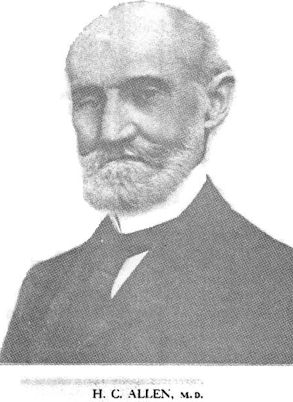
By Henry Clay Allen
Presented by Sylvain Cazalet
Dr Henry
Clay Allen
(1836-1909)“THE VITAL FORCE.”
– In the November number of last year, we took exception to Dr. Bayard’s
position as set forth in the Popular Science Monthly, in his
explanation of Homeopathy, that, as a science, it “is the law of
the vital force.” Dr. P.P. Wells, in a late number of the
Homeopathic Physician, has discussed the question at some length in his
peculiar way. Allowing all he says to be true, it reduces him to the
absurdity of attempting to prove a self-evident proposition. When the
point at issue is assumed by either party, to say the least, it cuts out
the party, so assuming, and argument is ended. We cannot, therefore,
follow Dr. Wells, since to our mind, the question is debatable, and
worthy of study; and is one which cannot be settled by flippant
assertions. It is also clear, that so broad a question cannot be
properly discussed in a brief editorial. We are not, however, disposed
to leave the controversy as it stands at present. We repeat, that the
facts of Homeopathy are one thing; the theories which help to explain
them are another thing. It is a necessity of the human mind to have
things explained. The best of all explanations, is a demonstration. A
thing which can be demonstrated is a scientific fact. We, however,
incorporate much into science so-called, which we cannot demonstrate;
and we explain, all such things by the help of theories. Many points are
settled by the theory of authority. An ecumenical council, a
synod, a conference or an individual, is often considered sufficient.
There are persons who would take Dr. Wells’ statement upon almost any
question as a final settlement of it. Upon this theory it is only
necessary to point out what the authorities say; and most of the hard
questions that might otherwise vex the mind of man, are in this way
answered and disposed of. Next to the theories of this sort, stand
theories founded on imagination or superstition. Given a
series of phenomena, apparently inexplicable, and all you have to do, is
to, construct an ideal cause. The ocean, the forest and the air were
once filled with imaginary beings, who drove the winds about, made the
seas boil and hurled thunderbolts through the heavens. Spirits, malign
and benign, filled every unexplored corner of the universe, and became
the efficient source of its mysterious phenomena. For centuries,
imagination, backed by authority, covered the whole ground, and solved
all riddles. Subsequently, Science came into the field, and claimed
her right to answer these puzzling questions. This she does in two ways:
First, by demonstration. She repeats the phenomenon at will and shows
every step in the experiment. In this way she curbs and controls
imagination and destroys the specters of superstition. But secondly,
science must employ theories respecting many things she cannot
demonstrate. But such theories are always essentially scientific
theories. They hold no relation to the theories of authority or
imagination, because in essence, they always correspond with the facts
of sciences.Now to the point at issue.
The phenomena of life were easily settled a thousand years ago by
imagining a life principle to exist in the living body This theory came
to us first by authority. The Bible settled the question when it
declared that God breathed into man and made him a living being. We had
the authority of the Church for it, and that was enough. But the
imagination now holds the same theory in place as a convenient solution
of life’s mysterious problems. It is however a theory, whether true or
false, that has in it no element of science. Once it was potent to shut
out all investigation. Life was “a sacred mystery,” and we
could raise no question which the “life principle” could not
solve. But during the last century, the investigator has invaded the
domain of life and stripped it of much of its mystery. And upon that
small part which yet is not capable of demonstration, it has resolutely
placed well defined scientific theories, and so, in effect, shut out the
old imagination of a “life principle.” As scientists we take
Matter and Force as our ultimates, and out of them construct, where
needed, good working theories, to which we hold tentatively until
demonstration shall come up take final possession. We have no need to go
outside of the laws which govern matter and force, to understand life
and disease, and the nature of drugs and the mode of curing disease.
Nothing can help us on with more certainty than Chemistry and Physics,
if properly applied. Upon these Homeopathy can stand with no fear of
falling. We reject the assumption of a “life principle,”
first, because it is an unscientific theory; and secondly, because it is
not needed to account for the phenomena of life or health or disease.
And we more especially object to making it the foundation of the
Homeopathic, healing art, because it is quite too shadowy and untenable;
and we can only lose by resting upon a false foundation. Dr. Wells
declares that “without this force as a chief factor, Homeopathy has
no philosophy; neither can there be without this force included
in it, any rational philosophy of lift, health or sickness.” And he
adds as his belief, that “it is indispensable to a useful and
successful practice of this philosophy.” But what we want is
not a rational philosophy but a scientific philosophy; and that
we certainly have, and it as certainly shuts out all superstitious
beliefs in the old and exploded notion of a “life principle”
otherwise known as “the vital force.”Copyright © Sylvain
Cazalet 1999