Notes on Sepia.
By Henry Clay Allen
Presented by Sylvain Cazalet
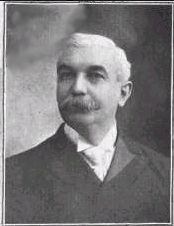
Dr Henry
Clay Allen
(1836-1909)This wonderful
anti-psoric has a profound action on nearly every tissue and organ of
the body, and like most remedies of its class its medicinal effect is
long lasting-a single dose being often sufficient for many weeks. It
appears to first expend its energy upon the brain and nervous system,
thus deranging the life forces, or as Hahnemann termed it the
“vital force,” and thus producing organic change. The tendency
is to produce organic change of tissue as first seen in its effects on
the skin, in the well known discoloration’s, “yellow-saddle,”
“moth patches” as well as the characteristic herpetic
eruptions ; hence the ability to cure the deeper and more malignant
diseases, epithelial cancer has been reported by Dunham and others as
coming within its healing influence.As “there is
nothing new under the sun” Sepia
is not by any means a new remedy. For dysmenorrhœa and other
derangements of women Hippocrates placed a high value upon it, and Galen
likewise used it extensively, but in what form we are not told, for
atonic conditions of the gastro-intestinal canal. Notwithstanding all
this it has not yet found an abiding place in the Pharmacopœia of our
allopathic brethren, as neither “Murrili’s Digest of Materia Medica
and Pharmacy” (1883), nor the “Sixth Decennial Revision of the
U. S. Pharmacopœia” makes any mention of it whatever. The chief
explanation of this rejection is probably due to the fact, that in its
crude form as drugs are usually compounded, it has been found to be
practically worthless. Like Alumina, Calcarea,
Carbo veg., Lycopodium, Natrum mur. and Silicea, the dominant school has not been
able to obtain results from Sepia that would warrant its introduction
into the Materia Medica. In our school, for his very reason, many
practitioners place little reliance upon it, its action being deemed
vague and uncertain. In this they are no doubt correct. Those of us who
accept Hahnemann’s law and reject his dynamic theory and its practical
results in our treatment of the sick, are not very much in advance of
our benighted half-brother of the other school. As Sepia is so
frequently used in alteration with Lachesis I want to point out some
objections to such practice based upon its pathogenesis.
CHARACTERISTICS.
Sepia.
Adapted to women of
dark hair and eyes, rigid muscular fibre, mild disposition, but are
easily offended and then are irritable and often vehement.Inclined to abdominal
adipose especially after child bearing.Climacteric troubles
especially when based on portal congestion.Hot flushes, sudden
accessions of heat followed by momentary sweat and disposition to
syncope.Paralytic affections of
pelvic and abdominal viscera.
Menses :
never regular, too early, too profuse ; too late and too scanty.Coldness on vertex.
Feet and ankles cold.
Yellow ; face,
conjunctiva, chest ; yellow saddle on cheeks or across nose. Herpes
on upper parts of body, < at menstrual period.Prolapsus ;
intolerable bearing down as if contents of pelvis would extrude from
body ; relieved by sitting down or crossing limbs. Usually feet and
ankles cold.Pains extend from other
parts to back ; are attended with shuddering not chilliness and are
relieved by motion or pressure.Sensation of ball in
inner parts ; during menses, pregnancy, lactation ; with
constipation, diarrhœa, hæmorrhoids, leucorrhœa and uterine
affections.< at New moon, in snowy weather, during or before a thunderstorm.
< on awakening when aroused from sleep (deep), but relieved after sufficient sleep.
Hæmorrhage :
during climacteric, pregnancy especially 5th and seventh months, flow
dark and sluggish.
Lachesis.
Suitable for women with
dark eyes and complexion, or red hair and freckled, inclined to low
spirits with indolent, choleric, melancholic temperament.Thin, emaciated,
changed mentally and physically by effects of disease.Climacteric troubles
when mental or nervous symptoms predominate.Hot flushes, burning
vertex headache, hæmorrhoids, hæmorrhages, especially after cessation
of menstrual flow.Paretic symptoms of
left side. Left sided apoplexy.
Menses :
regular as clock work, punctual almost to the hour ; too short, too
feeble, Pains relieved by flow. Heat on vertex. Feet, especially soles,
burning.Bullæ, yellow,
purplish or dark, from bloody serum. Carbuncle, malignant pustule, bed
sores with dark or black edges. Malignancy.Prolapsus ;
bearing down, labor like pains, as if every thing would issue from
vulva. Uterine region extremely sensitive to touch cannot bear clothes
to touch her. Constitutional symptoms are guiding.
Pains :
neuralgic, tearing stitching, pulsating, burning, < after sleeping, and from, noon till midnight.
Sensation as of worms
crawling in heels, bladder, rectum ; of beating as with little
hammers in rectum, temples, vertex.< in Spring, during extremes of heat or cold ; sun's rays.
< after sleep ; or the aggravation wakens him from sleep, or he sleeps into the aggravation. A mental condition.
Hæmorrhage during
climacteric ; blood lumpy, black or acrid. Hæmorrhagic
diathesis ; small wounds bleed much.
Sepia
and Lachesis are incompatible and like most
animal poisons should rarely follow each other and never to be given
together.A careful
individualization would certainly prevent such a catastrophe for the
patient, as they are rarely if ever indicated at such a time.Each of these
polychrest remedies has only obtained a foot, hold in the homœopathic
Materia Medica after a severe prolonged and bitter contest against the
doubts and unbelief’s of members of our school. But they have
nevertheless come to stay.
HEADACHE.
Dr. Rockford reports
the following case :Mrs. L—., of
nervo-sanguine temperament, had for several years a headache recurring
every Saturday. Thought it sometimes came from the noise of her children
who were home from school that day ; but so sure as Saturday came
the headache returned the pain was of a boring character from within
outward, and was attended with nausea and vomiting. Binding the head up
tightly gave some relief and if she could get a good sleep would awaken
much relieved. Sepia 200 cured.
Dr. H. C. Allen :
I was called 20 December, 1884, at 3 A. M., to visit a lady suffering
with a congestive headache, and requested to bring my “hypodermic
syringe or chloroform.” As I have no use for palliatives and do not
use either, I did not take them. She is 46 years of age, of medium size,
dark complexion, black hair and eyes, and except an occasional headache,
usually enjoys good health. Menstruation regular, normal ; occurred
two weeks ago. The present attack was attributed to some mental
excitement to which she had been subjected in the afternoon. The pain
began in the evening, and thinking to obtain relief she retired early,
but from the violence of attack was soon compelled to leave the bed and
walk the floor to obtain relief. The pain was pressing, throbbing,
bursting ; as if the head was too full ; as if it would burst
or force the globes from the orbits. The head face and neck were red and
hot, and the carotids throbbed violently. The pain was terrible, and she
declared she “would became insane if it continued another
hour.” The only relief she could obtain was by pressing the sides
of her head with both hands and walking as rapidly as possible from and
to end of a suite of three rooms. The character of the pain, the intense
congestion of head, face, eyes, and throbbing carotids, certainly
pointed to Belladonna, But the manner of obtaining relief from rapid
motion, which was here the most uncommon symptom, promptly excluded that
remedy. Any remedy that would cure this case must contain among its
totality, this peculiar symptom, which is a characteristic of Sepia. A
few pellets of Sepia 200 were prepared in water and a teaspoonful
ordered every ten minutes until relieved. Before the time for the third
dose had arrived, she had lain down on the lounge and was asleep, and
the next day was as well as usual. Would the “hypodermic” have
done the work quicker or better ? Should we not be thankful for a
law of cure, and does it not pay to follow its guiding star ?
EPITHELIAL CANCER.
Sepia
produces
swelling on lower lip with soreness, burning and a pricking, slivery
sensation. Guided by these and the constitutional symptoms, Dunham and
others were led to the employment of Sepia in the treatment of
epithelial cancer of lower lip. Two cases cured by Sepia 200 are reported by Dunham as having
come within his personal knowledge.
Dr Carroll DunhamDunham says, in his
Materia Medica :An epithelial cancer far developed
had been excised. The wound healed kindly. After a few months the
patient began to emaciate, and to exhibit every sign of cancer cachexia.
Eminent surgeons diagnosed internal cancer. The decline was alarmingly
rapid. No hope of recovery was entertained. The complex of symptoms
indicated Sepia, which was given 200 and effected a complete and rapid
restoration of health. The health remains good to this day (ten years).
NERVOUS SYSTEM.
Dr. Hesse reports the
following case showing its profound action on the nervous system :Mrs. H—., a delicate
brunette with pale face, con. suited the Doctor on account of spasmodic
shaking of the head The attacks begin suddenly, and with fearful
rapidity, the head is thrown to the right and left around its vertical
axis. She is perfectly conscious during the attack, without a
participation of any other part of the body, lasts several minutes and
repeats itself several times during the day, especially after emotions,
and she may remain free from them for several days. After an attack she
feels prostrated. From childhood on she always was nervous irritable,
and suffered from convulsions. The shaking of the head began four years
ago after a fright and it worse before or during menses, from emotions
and even when she meets persons disagreeable to her. Appetite fair, no
thirst, diarrhœa and constipation alternating. Nights restless, cannot
lie on her back, throws herself about and awakens unrefreshed. Much
flatulence in the morning which she relieves by gymnastic exercises,
better towards evening. Heavy atmosphere and hot rooms disagreeable ;
heaviness of head in foggy weather and before a storm. She always feels
restless, and cannot sit for a long while, she must do something ;
bites her nails, scratches her head or pulls out hair. Menses regular,
scanty ; during the interval moderate leucorrhœa. Hemicrania and
lightning-like dizziness. Cannot wear garters or rings, as her
extremities feel swollen. After the failure of Ignatia for a week she
received :July 2 : Sepia 30,
one powder a week.July 16 : After
every powder, the next morning a severe paroxysm ; on the other
days only very slight ones ; feels encouraged.Aug. 4 : No more
paroxysms, though she menstruated.Aug. 17 : A slight
attack. She complains of poor sleep and morning malaise. One powder.
Sepia 200.Oct. 12 : Sleeps
better. During November a severe aggravation followed from anxiety and
continued nursing of her sick family ; but gradually she improved
again under Sepia 1200, but Ø, doubt if her predisposition to nervous
affections can ever be entirely eradicated. We find under Sepia :“The head jerks
and twitches forward six or seven times with full consciousness ;
in the morning, jerking of the head backward when rising.”This gave a valuable
hint for its selection.
INTERMITTENT FEVER.
The paroxysm of the
Sepia intermittent strongly resembles that of Arsenic
in the mixed, irregular character of its different stages. As a rule
neither stage is prominent nor well-defined in Sepia, but is a very
picture of what is known as an undeveloped, partially suppressed or
“spoiled case,” -or as Hahnemann calls them “cases of
Cinchonism,” -by the use of Quinine or some-other anti-periodic.
The symptoms are so mixed with drug effect as not to appear to call for
any particular remedy, the completion in this class of cases strongly
resembles that of Sepia. It presents a sallow, dirty, doughy, sickly
appearance, and in all old cases of so-called “malarial”
poisoning we no doubt have portal stasis or congestion as the
pathological basis. The abdominal vessels in both these class of cases
are engorged, and they often find their simillimum in Sepia. In homœopathic
Practice, however, there is no such thing as “always will.”
There must be some symptomatic indication in harmony with the condition
presented by the patient, or the remedy will not, cannot. In many of
these cases a few doses of Sepia, high, will clear them up, effect a
return of the symptoms of the original, Paroxysm so that the curative
remedy may be readily selected, is class of cases, in the writer’s
experience, are more frequently met with in the South than the North,
but wherever found and correctly differentiated good results will be
obtained. Sulphur should not be over-looked here, if the symptoms
correspond.
DISCUSSION.
Dr E. H.
PorterDr. Porter :
I would like to ask
Dr. Allen if he honestly thinks that Sepia, or any other remedy in the
Materia Medica will cure cancer ? If we have any remedy or remedies
capable of curing cancer or other malignant affection very few members
of the profession have yet found it out. For one I have it yet to learn.
I doubt the diagnosis, and the cure.
Dr. Allen :
I have found very
few writers in our literature, or in any literature, more reliable as
accurate diagnosticians than Dr. Dunham. He would certainly be
considered as good authority as Dr. Porter or myself. But Dunham tells
us more emphatically that, “the complex of symptoms” presented
by the patient called for Sepia, and we all know that he prescribed for
the patient and not for the cancer. This is just where we so often make
our most serious blunders. We prescribe for our diagnosis, or the
diagnosis of some one else, and we too often base our prognosis on the
treatment of the other school instead of on that of Hahnemann. If we
would follow our law of cure in its entirely as laid down by Hahnemann,
we would see fewer cases of disease with a malignant termination. The
patient would be cured before he reaches the malignant line.
Dr. Obetz :
This reminds me of a
case which came into my hands from the old school in the early years of
my practice, when I was fresh from college and the Materia Medica
teaching of Dr. Barnes. A married woman, Mrs. F—., æt. 45, was
passing the climacteric. Although she had raised a family she had not
been well about 17 years. There was much general emaciation ; she
was unable to sit up the latter half of the day. Had a firm, hard tumor
in each breast for some time, attended with sharp, lancinating pains.
She presented a sallow, bleached appearance ; yellow patches on the
chest and the “yellow saddle” across the nose. The totality of
the symptoms were covered by Sepia and much to my surprise the 30
potency cured the case. It presented every appearance of malignancy and
had been pronounced malignant by other physicians. And yet, because it
was cured by Sepia 30, I never could think the tumors were malignant.
The authorities all say the true cancer is incurable by any internal
medication.
Dr. Porter :
I think there is
just where we make our mistakes. We think it a case of cancer, but it is
not. Our diagnosis is faulty. It is a generally accepted fact that after
tissue change has taken place, after the breaking down has begun, there
is no remedy that will cure a case of cancer.
Dr. Allen :
Every disease, and
especially those profoundly-affecting the entire system, has its stages
of advancement distinctly marked, and it is possible that in every case
of cancer there is a line of demarcation between malignancy and
non-malignancy ; a line within which the tumor is benign, and
beyond which it is malignant. This probably is equally true to every
fatal case of sickness. In the cases of both Dr. Dunham and Dr. Obetz I
have no doubt of the correctness of the diagnosis but the homœopathic
remedy stayed the progress of the affection and prevented what might
have been a fatal termination. How it disheartens a physician to
prescribe for what he believes a fatal case, according to his prognosis.
But if he would only close his eyes to his pathology, diagnosis and
prognosis and rely on the “totality of the symptoms” as laid
down by Hahnemann he would often be as agreeably disappointed as was Dr.
Obetz.
Source :
Medical Advance, 1886.
Copyright © Sylvain
Cazalet 2001