The chronic child.
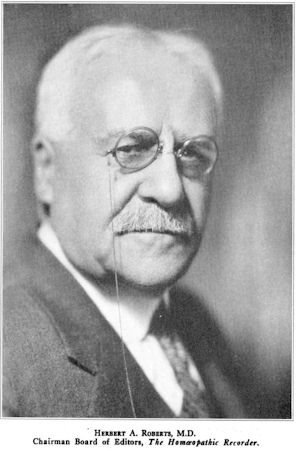
By Herbert
Alfred Roberts, M.D.
Presented by Sylvain Cazalet(Read before I. H. A., Bureau of
Obstetrics and Pediatrics, June 27, 1936.)
Dr H. A. Roberts
Theoretically, if we
could have the child under homœopathic treatment from birth, and if we
could govern diet, hygiene and environment as well, there would be
little adult practice for us, Actually, there are other problems to
consider, conditions over which we have little or no control ; and
there is always the problem of our own insufficiency or lack of
knowledge ; lack of understanding of the child’s actual condition,
of his needs, of the needs of his parents or more distant
ancestors ; and worst of all, too often lack of knowledge of our
materia medica, its possibilities and how and when to utilize it.Somewhere between the
actual and theoretical lies the field of possibilities open to us ;
it is to the extent that we avail ourselves of these possibilities that
our success may be measured. We must face that there are always
obstacles that may prove insurmountable ; there is the ever present
probability of conditions beyond our control. There are hereditary
tendencies that may be curbed but may not be eradicated in one
generation. There are the problems of ignorance and poor environment and
difficult financial conditions-too often a vicious circle. There are
always those who are destined to rise strong and healthy from the worst
environment and hereditary ; there always will be those who
sink to a lower level, mental, physical and spiritual, from the best
conditions.If we could have an
adequate endowment for homœopathic care of under-privileged children,
who are sick of mind, body or spirit, we unquestionably could save many
to useful futures who would be otherwise not only problem children but
problem adults. If homœopathy were given a free hand in treating the
chronic child, homœopathy could render tremendous service in spite of
discouraging backgrounds.Everything else being
equal, we may assume that a sickly child prognoses a sickly adult ;
that is, the chronic child becomes the chronic adult sufferer. If the
child’s need is met homœopathically early in life, whether this be the
similar remedy or the similar disease, it will do much to correct the
chronic tendency ; but the normal course of a similar disease all
too often meets with suppression and the result is more deeply rooted
chronicity. If we can teach the parents the dangers of suppression, and
to comprehend that a succession of acute illnesses is in reality a
chronic manifestation in ever-repeating and ever-varying forms, we shall
have gone far toward laying a basis for constructive treatment of the
chronic child.Consider a typical
history. At a very early age the babe presents feeding problems :
the mother’s milk disagrees, or she may wish to avoid the trouble of
nursing. If the child is taken to a clinic probably evaporated milk will
be recommended as making the baby “fat and healthy”. Rapid
gain in weight is a real danger in these days of baby clinics and the
frequent comparison of weight with other babies. Presently a rash
appears ; ointments are prescribed.If this is a successful
suppression the next step may be bronchial “colds”. Probably
the child has had a succession of nose colds for some time. Too often
there is abnormal perspiration. If this rate of progress is maintained
the child will be a confirmed chronic-probably asthmatic-by the time he
is two years of age, and perhaps even before he reaches his first
birthday. This picture is not an exaggeration, but the actual
observation of case histories in many small patients who have been under
popular treatment, either through clinics or under the care of
intelligent but uninstructed physicians.If the child survives
puberty, when the hereditary taints will appear to add to the chaos, he
will go on into adult life carrying an increasing burden and with a
decreasing ability to participate in normal interests, unless he
receives that help he so sadly needs.Here is a boy thirteen
years of age. Leonard is asthmatic, and so worn and weary by his
sleepless nights that he cannot respond to the tasks laid on him in
school. Directed by his teacher, who has witnessed the power of homœopathy
on her own suffering mother, the boy was brought by his father, an
illiterate Italian. This was the history : Dyspnœa < night, < on lying down, < rainy weather, < winter and foggy weather, > sunny and warm weather. Always wheezing ; sneezing frequently.
Coughs a great deal, with thick green sputum.Weight on chest during
the attack ; sweats with the attack. Thus far no spectacular
symptoms have been given ; the identifying concomitants are
lacking. He cannot play long with the other boys, for while he is
restless and active he soon tires, and this brings on pains in the arms
and legs ; running causes pain in the head, about the heart, and in
the extremities. His lips get blue at such times. These asthmatic
conditions appeared before he was a year old ; as a babe his head
was covered with scabs which disappeared under the application of
various ointments. These eruptions appear only at rare intervals now,
and they never thought until now that his breathing is better while the
eruption is out.A chronic child,
heading for a chronic adult-if his heart does not fail under the
strain ! Rhus tox. 10M. on November 4, 1935, and placebo since, has
made this child over into a normal, healthy boy. Some eruption
reappeared but cleared of itself, without repetition of the remedy. This
child belongs to that class we designate as under-privileged, but
instead of a potential social problem he is a potential worker.Seven-year-old Rita has
a chronic history that dates back to first dentition, perhaps farther.
As a matter of fact, it dates back to her ancestors, for her
grandmother, aunts and cousins all have asthma ; Rita herself has
notched teeth. Always sore throats as a tiny child ; tonsils were
removed at four years but the sore throats continued. Continual colds
since babyhood ; colds in the head every time she goes out to
play ; these hang on for a month and run into asthmatic attacks.Cankersores in the
mouth. Cries out and talks in her sleep ; rubs her nose frequently,
even in her sleep. No appetite. Exertion, even a natural amount of play,
brings on asthmatic attacks. It is not necessary to go into the detailed
symptomatology of the attacks ; it is sufficient for our purpose to
point out the tendency toward a frail adolescence and invalid adult
period ; even now the child has the appearance of a fragile
ornament. Phosphorus 9M. gave wonderful impetus toward health. Later,
because of early decay of the teeth and a closer study of the remedy.
Calc. phos. seemed indicated and did even better work.This year Rita’s mother
wrote that for the first time in years Rita was able to go out doors and
play with the other children before summer came, without taking cold.A young woman with
great courage and patience adopted a three-year-old fairy child.
Virginia’s mother was dead, probably from tuberculosis ; the
father, a confirmed drunkard, committed the child to an institution. The
child was frail, slender and waxen. The new mother believed in good
feeding, care, and homœopathy, and gave the child a chance to win
against the chronic background. Yale Medical School x-ray plates,
required before the child was permitted to leave the institution,
revealed well defined tubercular lesions in the chest ; the sputum
was positive for tuberculosis. The first “acute” condition was
a discharging ear.On a single dose of
Sulphur she did well for several months. Then she developed night
sweats, especially about the head, and Calc. carb., one dose, carried
her for a year. She grew and thrived. After several months a series of
seemingly acute conditions, at first treated with what we arbitrarily
class as acute remedies, yielded to Lycopodium. After a time the family
moved to another city, where she has continued under homœopathic care ;
but reports from time to time indicate that there has been no serious
illness and few acute attacks of any kind. Thus good care in the home
plus the simillimum hove given this delicate child a very fair chance to
attain a normal, healthy adult life.George, just in high
school at 17 years of age, was brought to homœopathy through the
influence of friends of the family who knew what homœopathy could do
when given a chance.George was a perfect
example of the “chronic” child. The history began at two years
of age, with an oozing eczema all over the body. This had been
successfully suppressed by the time he was five, but long before that he
had developed a tendency to take cold ; if it were an east wind he
had a nose cold, if some other breeze played upon him it was a cough, or
a sore throat-he ran through the complete series repeatedly. In the
brief intervals between colds, measles, chicken-pox and whooping cough
did their best to clean house. Digestive difficulties set in. Tonsils
and adenoid tissue were removed and heart symptoms developed, but there
was no recession in the other difficulties. With this chronic picture
mental retardation became quite marked, and the poor psychic effect of
his noticeable difference from other boys was an added factor toward
chronicity.After a year of homœopathic
treatment George’s mother writes : “Everyone who knew George
as he was marvels at his condition now. His health is excellent and he
is getting on well in school. His father and I appreciate this more than
we can say.” Sulphur 1M.
started him on the right track ; Puls. 200, an occasional dose for
“acute” conditions, carried on the good work. George faces the
cheerful prospect of a useful manhood.Harvey came to homœopathy
when he was seven years of age. Here are the pertinent items of his
history : dentition difficult and irregular ; eczema on the
face and body “cured” by salves at eight months. Colds
continuous since one year of age ; antitoxin and vaccines at
different times before he was five-and-a-half. Asthma developed before
he was five. Tonsils and adenoid removed at about that time. Ulcers on
one eye. Sweat, particularly about the head. He tumbles, screams and
jumps in his sleep. Two doses of Sepia 1M. in three years have made this
boy over. His case was so spectacular in the eyes of the specialist who
had “done every thing” for the boy that the specialist
threatened to send more patients for the privilege of observing their
reactions-but he is still threatening.Marcia developed a limp
at five years of age. She comes of a family with a very chronic
history : all her mother’s family failed to erupt ? full set
of teeth ; some teeth were markedly notched ; some members of
the family had extensive psoriasis ; all the aunts were hysterical
almost to the borderline. Marcia’s parents were what might be termed
intermittent homœopathic patients, so not content with medicine, they
decided Marcia must have up-to-date treatment. So she was hustled off to
one specialist after another ; she was hospitalized and later she
wore a brace for a year. At last Marcia came back into homœopathic
hands, and in spite of the tubercular hip condition that the early
x-rays revealed, Pulsatilla at lone, intervals has taken care of Marcia
and her occasional acute manifestations as well.These are not intented
as case reports. Rather, they are given as corroborative evidence of our
claim that the “chronic” child has an excellent chance to gain
normal health, even against heavy odds of environment and heredity. Not
every child can be saved ; there is a certain percentage of
circumstances against this ; but given the opportunity, how many
children can be saved to a useful, productive life with interesting
opportunities for future generations ?In order to accomplish
sound results we must recognize the sequence of events ; we must
give due thought to hereditary problems. The delicate child, with silky
hair and waxen skin, who develops severe headaches upon application to
school work, severe nosebleeds, the tendency to take cold, sensitive to
every breeze, emotionally unstable, is not manifesting a series of
unrelated conditions. We must realize the tendency for this child to
develop an active tuberculosis ; and we must recognize it before
the x-ray reveals a lesion if we are fair to our healing art and to the
child’s future. While we know that even if the condition has developed
into active manifestations the child may be saved for a healthy future,
we must stress the fact that regeneration will not be brought about by
careless prescribing.In other words, we must
look to past history for background, to the present symptomatology as a
stage in profession, and to our homœopathic materia medica for that
power which unlocks the patient’s vital energy to cure, which is our
goal for the patient’s future.
DERBY. CONN.
DISCUSSION.
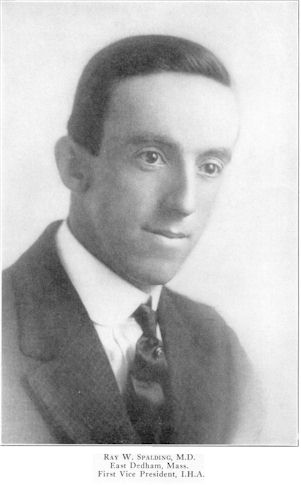
Dr R.
W. SpaldingDr.
Heimbach: I just want to relate my experience with an
infant that I delivered at birth. We couldn’t get anything to agree with
that child, breast milk, or any other combination. It had diarrhœa and
vomiting until the child was pretty well emaciated, then I discovered
she had influenza. China sulph. 30x,
in two weeks, time brought her along very nicely, and she is a very
husky girl now.
Dr. Spalding :
This paper decries careless prescribing, which, after all, is one of the
difficulties of almost everyone. There is no question but that many,
many children can be brought to useful manhood and womanhood through the
application of a homœopathic remedy. It is important to get the right
remedy to begin with in this sort of work, much as in the cancer cases,
and the only thing I could possibly add is that regardless of the time
it takes to study the case, do not hurry the prescription ; if
necessary, observe the child two months, and I believe the work will be
very much more satisfactory.
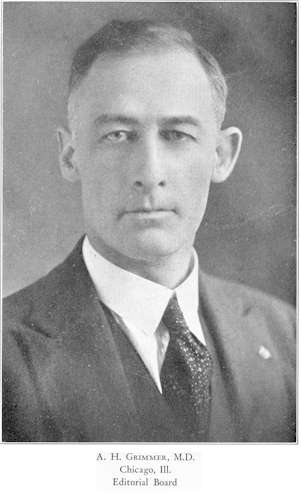
Dr A. H. GrimmerDr.
Grimmer: There is no short-cut to real homœopathic
prescribing, but work, work, work. It seems the farther along the road
we get, the more we have to work, the more we can do, the more work we
have to do, but we never cease to get a thrill and kick out of a case
that is held by a homœopathic remedy.
Dr. Panos :
Dr. Roberts brought out if a child is attended, the child naturally in
later life will have less troubles from chronic conditions, not only
physically but mentally, and we will have less criminal problems.
Healthy minds and healthy bodies make fewer criminals.I would like to ask Dr.
Roberts if he ever had cases where under such prescription the indicated
remedy did not restore the child to health, and also if the posture of
the child has been taken into consideration. I think that fact should be
taken into consideration in the growing child where the indicated remedy
does not restore the child to complete health.
Dr. Roberts :
I
said in my paper there were cases that were beyond the control of
anyone. There is a possibility of that, always. My plea’s for the homœopaths
to get back to the foundation in prescribing and more of them take up
pediatrics. You know this school of medicine can make the “old
school” look sick if they just get into pediatrics and do the
things that are possible to be done.
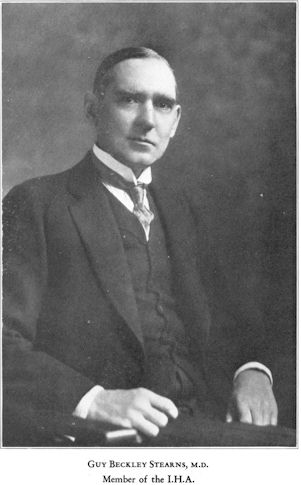
Dr G.
B. StearnsDr.
Stearns :Dr. Roberts, does Tuberculinum come often for
you in those cases ?
Dr. Roberts :
Not
very often ; comparatively seldom.
Dr. Stearns :
We find it useful occasionally ; it wakes up the case that fails to
react to good constitutional prescribing.
Dr. Roberts :
Sometimes it wakes it up, but it seldom cures it.
Dr. Stearns :
We have never had any harm from it. It opens up the case so the
constitutional remedy is more clearly seen.
Dr. Roberts
:
You get the right remedy, and it will open up ; you give Tuberculinum
and it carries you along for a little way and you think you are on the
road to recovery, and you are not always. Dr. Margaret Webster brought
out Tuberculin in the Recorder
recently, and she makes this statement : That the nosodes seldom
cure.I do feel that we
should go more into pediatric work. The possibilities of a young man
going into the practice of medicine and specializing in pediatrics is
simply marvelous today because they can walk away with the “old
school’s” work right away.Who asked about
tonsillitis ? I said I didn’t see why you asked such a silly
question. Does the removal of a tonsil ever cure the patient ?
Source :
Homœopathic Recorder,
April, 1937.Copyright © Sylvain
Cazalet 2001